On a Global Standard deployment, Azure OpenAI bills gpt-5.2 at exactly the same rate as the direct OpenAI API, $1.75 per million input tokens, $0.175 cached and $14.00 output, on both grids read on 15 August 2026.

The bill only diverges when you pin the deployment to a data zone, which adds 10 percent in the US and Europe and 20 percent in Asia Pacific and India, when you pick one of the two models where Microsoft has published its own rate, or when you move to provisioned throughput.
The calculator below takes your monthly token volume and returns the yearly gap between each option and the direct API. Every figure carries the date it was read and the source it came from.
Azure OpenAI against the direct OpenAI API
Enter your monthly volume. The table returns the monthly bill, the yearly bill and the yearly gap against the direct API for the same model. List prices in USD, read on 15 August 2026 from the Microsoft retail price API and the OpenAI pricing docs.
Short context rates. Global Standard lets Microsoft route the request to any region with capacity. Data Zone pins processing to a geography and carries an uplift. Where a model has no Data Zone meter published for a geography, that row is omitted rather than estimated. The OpenAI rates were re-read on 5 September 2026; the Azure meters are as we read them on 14 August 2026 and have not been re-verified since.
Azure Global Standard and the OpenAI API charge the same price
The question behind the search is almost always the same: does routing an existing workload through Azure change the token bill? For most models, no. We pulled every Azure OpenAI meter from the Microsoft retail price API on 15 August 2026 and set it next to the OpenAI pricing docs read the same day. gpt-5, gpt-5-mini, gpt-5-nano, gpt-5.2, gpt-5.2-pro, gpt-5.4, gpt-5.4-mini and gpt-5.4-nano all line up to the cent on Global Standard. We re-queried the same API on 10 September 2026 and those meters are all still published, at the same rates. So do the Batch meters, and so does the tier OpenAI renamed Fast on 30 July 2026, which Microsoft still labels priority.

That parity is the single most useful thing to know before anyone builds a migration spreadsheet. On Global Standard, the cloud you buy the tokens through is not the variable. The deployment type is.
The gpt-5.2 grid on both sides, 15 August 2026
| Rate per 1M tokens | OpenAI API, direct | Azure Global Standard | Azure Data Zone, US or EU | Azure Data Zone, APAC or India |
|---|---|---|---|---|
| Input | $1.75 | $1.75 | $1.925 | $2.10 |
| Cached input | $0.175 | $0.175 | $0.1925 | $0.21 |
| Output | $14.00 | $14.00 | $15.40 | $16.80 |
| Batch input | $0.875 | $0.875 | $0.9625 | not published |
| Batch output | $7.00 | $7.00 | $7.70 | not published |
| Fast or priority input | $3.50 | $3.50 | $3.85 | not published |
| Fast or priority output | $28.00 | $28.00 | $30.80 | not published |
Azure adds 10 percent for a US or EU data zone and 20 percent for APAC or India
Batch halves the standard rate on both sides in exchange for a 24 hour window. Fast doubles it. Those two multipliers move a bill far more than the choice between Microsoft and OpenAI, which is why a comparison that only shows the standard row tends to answer the wrong question.
Where parity breaks: terra and luna on Azure
Two model names do not match, both in the 5.6 family. OpenAI lists gpt-5.6-terra at $2.00 input and $12.00 output for short context. The Microsoft meter named 5.6 terra ShortCo Inp Std Gl, effective 1 July 2026, reads $2.50, and its output meter reads $15.00, a flat 25 percent above. gpt-5.6-luna is wider: $0.20 and $1.20 on OpenAI, $1.00 and $6.00 on Azure, five times the rate. gpt-5.6-sol matched exactly at $5.00 and $30.00 when we read both grids on 14 August 2026. OpenAI has since cut it to $4.00 and $20.00, and we could not re-read the Azure meter for that model: the Azure pricing page renders its figures in JavaScript and the Foundry model documentation lists the 5.6 models without their rates. Treat that row as dated until Azure is read again.

We could not reconcile that gap from public documentation and we are not going to invent a reason for it. It may be a Microsoft margin on the smaller models, a differently served configuration behind the same name, or a meter that has not been refreshed. If terra or luna is your volume model, check a real Azure invoice before you plan a budget around either number. The calculator uses the Microsoft meters exactly as published.
Where Azure costs more on purpose: the data zone uplift
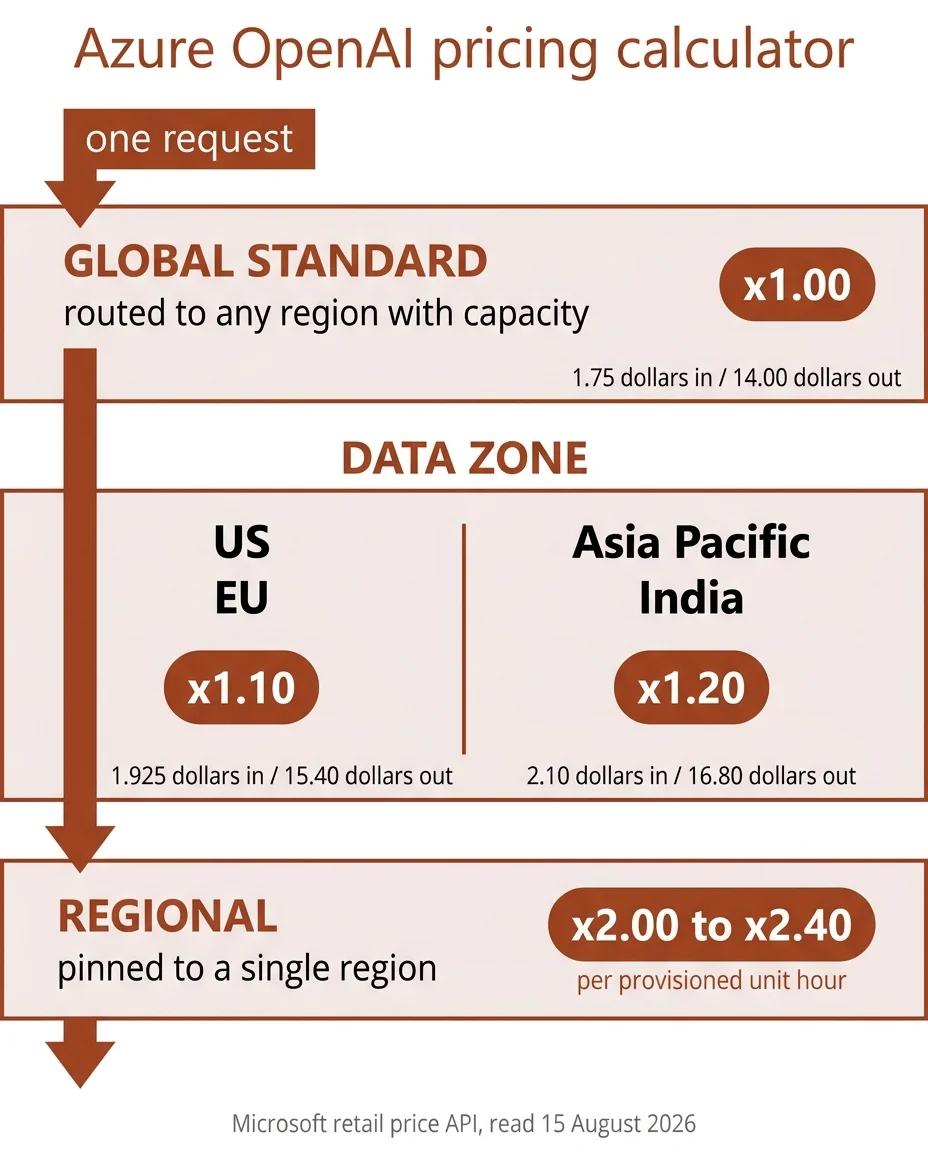
Global Standard lets Microsoft route your request to any region that has capacity, anywhere in the world. Data Zone pins processing to a geography, and Microsoft charges for that guarantee. As of 15 August 2026 the uplift comes in two bands. In the US and Europe it is 10 percent, so gpt-5.2 goes to $1.925 and $15.40. In Asia Pacific and India it is 20 percent, so gpt-5.2 goes to $2.10 and $16.80. That second band covers Australia East, Southeast Asia, Central India, South India, Jio India West and Japan East, and those meters became effective on 1 June 2026.
What the uplift does to a real monthly bill
Take 200 million input tokens and 20 million output tokens a month on gpt-5.2, no cache. Global Standard and the direct API both come to $630 a month and $7,560 a year. Data Zone in the US or Europe is $693 a month and $8,316 a year, a gap of $756. Data Zone in Asia Pacific is $756 a month and $9,072 a year, a gap of $1,512. Residency is a real cost, and it is the main reason an Azure bill ends up above an OpenAI bill for the same traffic.
One thing worth noting before you treat that as an Azure penalty: OpenAI now applies its own 10 percent uplift on regional processing endpoints for models released on or after 5 March 2026. Data residency costs money on both sides. It is no longer a reason to prefer one provider over the other.
Where Azure can cost less: provisioned throughput
Provisioned throughput is the part of Azure that has no OpenAI equivalent on a public price list, and it is where an enterprise workload can genuinely come out cheaper. As of 15 August 2026, a Global provisioned unit costs $1.00 per hour, which is $720 over a 30 day month and $8,760 a year. A one month reservation on the same unit is $260. A one year reservation is $2,652, which works out at $221 a month. Reserving a year of Global provisioned capacity therefore costs about 30 percent of what the hourly meter would charge for the same unit.
Data Zone provisioned runs $1.10 per unit hour in the US and Europe and $1.20 in Asia Pacific and India, with one year reservations at $2,916 and $3,180 across those same two bands. Regional provisioned, pinned to a single region, is $2.00 to $2.40 per unit hour with one year reservations from $2,916 to $3,504. US Government regions sit above all of it, at $2.50 an hour and $3,648 a year. The pattern is consistent across the whole grid: the tighter you pin the geography, the more you pay.
The volume where a reservation beats per-token billing
A reserved Global unit pays for itself once the deployment it replaces spends more than $221 a month, which on gpt-5.2 output alone is roughly 15.8 million output tokens. That is a floor, not a plan. One provisioned unit buys a fixed tokens per minute allowance that differs by model, and Microsoft publishes that allowance in the capacity planner inside the portal rather than in the price list. We did not verify the tokens per minute figure for any model, so the crossover above tells you when a unit is worth buying, not how many units you need.
What the official Azure pricing calculator does not show you
Microsoft’s calculator prices Azure. It has no column for the direct API, so the number an enterprise actually has to justify, the yearly delta of moving the same workload, is not in it. It also prices deployment types without telling you that two model names carry Microsoft rates rather than OpenAI rates, particularly as model transitions occur, such as the gpt-4o retirement on Azure. And the public pricing page it links to renders its figures client side: fetch that page as a document and every cell reads a dash, which is why the numbers here come from the machine readable retail price API instead.
If you are comparing across providers rather than across clouds, our comparison of LLM API pricing per million tokens puts every major model on the same grid. For the model level detail behind the figures used here, including where gpt-5.2 stops being the cheapest way to run a given task, see GPT-5.2 pricing and what the tier actually buys you.
How we read these prices, and what we could not verify
Verified: every Azure figure on this page comes from the Microsoft retail price API queried on 15 August 2026 in USD, across the Azure OpenAI and Azure OpenAI GPT5 products under the Foundry Models service, plus the Azure AI Foundry Provisioned Throughput Reservation product. Every OpenAI figure comes from the pricing page in OpenAI’s developer documentation, read the same day. Both are list prices, before tax.
Not verified: the tokens per minute delivered by one provisioned unit, which is not in the price list; the reason for the terra and luna gap; any Enterprise Agreement, Azure commitment or startup credit discount, none of which are public and all of which apply to the Azure side only; and the cancellation terms on provisioned reservations. We also did not use the Azure pricing page itself as a source, since its figures never appear in the served document.
Frequently asked questions
Is Azure OpenAI more expensive than the OpenAI API?
Not on Global Standard, for the large majority of models, where the two grids matched to the cent on 15 August 2026. It is 10 to 20 percent more if you need data zone residency, and it is more on gpt-5.6-terra and gpt-5.6-luna, where the Microsoft meters sit above the OpenAI list.
Does Azure bill anything on top of the tokens?
An Azure OpenAI resource on a Standard deployment has no standing fee: you pay per token and nothing else. Provisioned deployments bill by the hour whether or not traffic arrives. Everything you attach around the model, storage, private networking, log retention, is billed by those services separately and does not appear in any of the figures above.
Do enterprise agreements change these numbers?
Yes, and there is no public version of that arithmetic. Every price here is retail list. A committed Azure spend agreement is the lever most large buyers actually pull, and since it applies to the Azure side only, it is also the most common reason a real Azure bill lands below the direct API despite identical list prices.
Which deployment type should you pick?
Global Standard unless something forces you off it. Move to a data zone when a contract or a regulator requires the processing geography, and accept the 10 or 20 percent as the price of that clause. Move to provisioned throughput when you need latency guarantees, or when one deployment reliably spends more per month than a reserved unit costs. Run the numbers in the calculator with your own volume before you decide, because the answer flips on the ratio of output to input tokens far more often than on the provider.