The advertised monthly price of an AI girlfriend app is rarely the amount that leaves your account. Across the five apps we checked on the US App Store on 15 August 2026, the nine paid plans run from $4.17 a month on Replika’s annual plan to $86.62 a month if you take Chai Ultra by the week, and image credits are billed separately on top of all of it. On one single product, the billing period alone moves the bill by a factor of 3.9.

This page rebuilds the real monthly figure from the published in-app purchase prices. The last section covers the part nobody prices at all: what happens to your companion and your chat history the month you stop paying.
What the app stores actually charge
Companion apps do not publish a pricing page the way an API provider does. There is no grid to read, no per-unit rate, and in most cases no public plan comparison at all: you find out what the tier costs when the paywall appears inside the app. The one place where the numbers are published in full is the App Store listing, which is obliged to enumerate every in-app purchase and its price. That is where all the figures below come from, read on 15 August 2026 from the US storefront.

Replika, Character.AI, Nomi, Kindroid and Chai side by side
Every one of these five apps is free to download and monetizes entirely through in-app purchases. Here is what Apple lists for each of them, with the effective monthly cost of the annual plan worked out in the last column.
| App | Plan | Monthly | Quarterly | Annual | Annual per month |
|---|---|---|---|---|---|
| Replika | Pro | $7.99 | not offered | $49.99 | $4.17 |
| Nomi | Launch Plan | $9.99 | not offered | $59.99 | $5.00 |
| Character.AI | Character.AI+ | $9.99 | not offered | $94.99 | $7.92 |
| Nomi | Standard Plan | $15.99 | $39.99 | $99.99 | $8.33 |
| Chai | Premium | $13.99 | not offered | $134.99 | $11.25 |
| Kindroid | Subscription | $15.99 | $42.99 | $159.99 | $13.33 |
| Chai | Ultra | $29.99 | not offered | $269.99 | $22.50 |
| Kindroid | Ultra | $28.99 | not offered | not offered | no annual SKU |
| Kindroid | MAX | $68.99 | not offered | not offered | no annual SKU |
One app people shortlist is missing from that table on purpose. Candy AI does not sell through Apple: it bills on its own site, in euros, at 3.99 euros a month on a twelve-month plan, 8.99 euros on three months and 13.99 euros month to month, read on 16 August 2026. Mixing a euro web price into a table of dollar App Store prices would produce a ranking that means nothing, so it sits in our comparison of the best AI girlfriend apps instead, where it is priced on its own terms.
Two things stand out immediately. The entry tier clusters tightly between $7.99 and $15.99 a month, so the app you choose barely moves your bill at that level. And the top of the range is not a companion app at all in the usual sense: Kindroid MAX at $68.99 a month is closer to an inference budget than to a subscription, which is the same logic you see when you read the per-million-token grid the underlying models are sold on.
Why the same app shows several prices at once
Apple’s listing for Replika is the clearest example of a pattern that runs through this whole category. It shows a monthly SKU at $7.99 and another at $14.99, an annual at $49.99 and another at $69.99, plus a one-off called Replika Platinum at $89.99. Those are not tiers. They are price points that were current at different moments, kept alive because subscribers who signed up under an old one keep paying it until they cancel.
The practical consequence is that the price you see in the app is the price for a new account created on your device, in your country, this week. It is not a stable published rate, and it is not necessarily what the person telling you about the app is paying. Any figure quoted here, including ours, is a snapshot of one storefront on one day.
$4.17 a month on the annual plan, the cheapest month of the four
The billing period costs more than the app
Once you line the SKUs up, the single largest cost variable is not which app you pick. It is how often you get billed for it. That is the lever this page is built around, and it moves the number by a factor of nearly four between the two extremes.
Weekly billing is where the money goes
Chai is the only app in this group that sells a weekly subscription, and it is worth doing the arithmetic. Apple lists two concurrent weekly prices for Premium, $5.99 and $7.99; the figures here use the higher one.
Premium at $7.99 a week is $415.48 over a year, against $134.99 for the same tier billed annually. That is 3.1 times the price for the identical product. Ultra at $19.99 a week is $1,039.48 a year, against $269.99 annually, a factor of 3.9. Expressed as a monthly figure, weekly Ultra costs $86.62 a month while annual Ultra costs $22.50.
Weekly billing exists because it makes the paywall look cheap at the moment of the decision. Eight dollars feels like nothing. Nobody multiplies by 52 while a subscription sheet is open. If you take one thing from this page, it is that a weekly price on an AI girlfriend app should be read as an annual price divided by 52 and marked up threefold.
What a year up front really saves
Annual discounts in this category are unusually wide, and unusually inconsistent. Replika Pro at $49.99 a year against $7.99 a month is 47.9 percent off. Nomi Launch at $59.99 against $9.99 monthly is 50.0 percent off, the deepest in the group. Nomi Standard at $99.99 against $15.99 monthly is 47.9 percent. Then the discount collapses: Character.AI+ at $94.99 against $9.99 monthly is 20.8 percent, Chai Premium is 19.6 percent, and Kindroid at $159.99 against $15.99 monthly is 16.6 percent, the thinnest annual saving of the nine plans.
Kindroid also sells a three-month SKU at $42.99, which works out to $14.33 a month, nearer its annual rate of $13.33 than its monthly $15.99. Nomi’s quarterly at $39.99 is $13.33 a month against $8.33 annually. Quarterly is the tier to take when you are unsure the app will hold your attention past the first month, and it is priced accordingly.
Billed in euros on the web, so not comparable to App Store dollars without converting
Credit packs, the second bill
Two of the five apps sell consumable credits on top of the subscription, and this is the line item that turns a $9.99 plan into a $25 month without anyone noticing. Credits buy generated images, extra companions, and in Kindroid’s case voice minutes.
The price per credit is not flat
Nomi sells credits in five pack sizes, and the unit price falls steeply with volume. Doing the division on the published prices: 40 credits for $4.99 is $0.125 each, 100 for $9.99 is $0.100, 225 for $19.99 is $0.089, 600 for $49.99 is $0.083, and 1,800 for $99.99 is $0.056. The largest pack is 2.25 times cheaper per credit than the smallest one. Kindroid’s selfie credits behave the same way: 50 for $6.99 is $0.140 each, 100 for $11.49 is $0.115.
Those unit rates are what you pay only if you buy at that volume, which is why we price credits as whole packs rather than per image. Buy 20 credits a month on Nomi and you pay $4.99, the smallest pack, not 20 times the best-case $0.056.
The pattern is the same volume-discount curve you find on inference itself, except that here the discount is realized only if you commit cash before you know how much you will use. Buying the small pack repeatedly is the default behavior and the expensive one, in exactly the way a free tier quietly becomes a bill in a provider that advertises itself as free.
Slots, selfies and voice minutes
Kindroid unbundles further than anyone else in the group. One additional companion slot is $3.49, four slots are $11.49, which is $2.87 each. A block of 500,000 audio credits is $14.99.
None of those are covered by the base subscription. A user on the $15.99 monthly plan who adds the four-slot pack at $11.49, one 100-selfie pack at $11.49 and one audio block at $14.99 is at $53.96 for the month rather than $15.99, and the subscription is the smallest line on the bill.
Replika’s gem packs, from $0.99 to $19.99, and Character.AI’s Charms packs, from $0.99 to $99.99, are also consumables, but neither store listing publishes how many units each pack contains. We can tell you what they cost and not what they buy, so we have left them out of the figures rather than guess a unit rate.
What the free tier gets you before the wall
All five apps are listed as free downloads, and all five are usable without paying. What none of them publish, in the store listing or on a pricing page, is where the wall sits: how many messages a day, how many images a month, how much memory. Those quotas are set server side, differ by region and cohort, and are changed without announcement. We are not going to quote a message limit we cannot source.
What is worth knowing structurally is that the free tier in this category is not a capped version of the paid one. It is usually the same conversation with a slower or smaller model behind it and a shorter memory, which means the thing you are buying when you subscribe is often continuity rather than volume. That distinction matters more than the price, because it is what makes cancelling feel like a loss.
What happens to your data when you stop paying
This is the part of the purchase nobody prices, and the part that separates a $10 subscription from a $10 subscription you cannot leave. Two different events get confused constantly, and they do very different things to your history.

Lapsing is not deleting
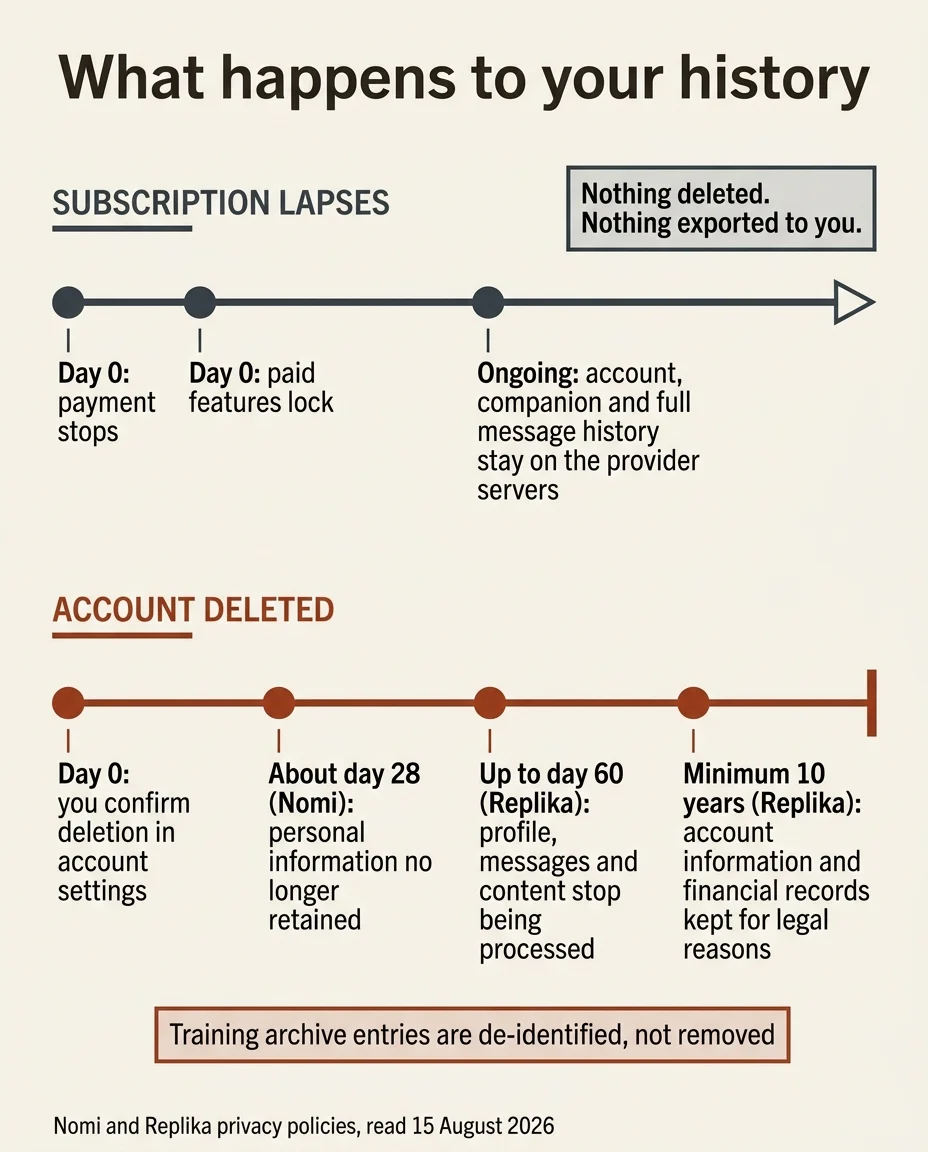
Letting a subscription lapse ends the payment and nothing else. Your account persists, your companion persists, your message history persists on the provider’s servers, and the paid features simply stop responding. Nothing is erased and nothing is exported to you. Deleting the account is a separate action, taken inside account settings, and it is the only one that starts a retention clock.

What the retention policies actually commit to
Nomi’s privacy policy, read on 15 August 2026, is the most explicit of the ones we could reach. It states that “none of your personal information is retained upon the deletion of your account”, that deletion completes “within 28 or so days of confirmation of deletion”, and, on the training question, that “upon deletion, any information in our training archives would no longer be attributable to you”. Read that last clause carefully: the archive entry is de-identified, not removed.
Replika’s privacy policy, read the same day, commits to processing “your profile information, messages and content, interests and preferences for up to 60 days after termination of the contract”, while account information and financial records are kept “for a minimum period of 10 years after termination of the contract due to legal retention requirements”. So the conversations go in two months and the billing trail stays for a decade. Separately, Apple’s privacy label for the app lists Identifiers and Usage Data under Data Used to Track You, and coarse location, name and email address under Data Linked to You.
Export before you cancel, not after
The order of operations matters. Once an account is deleted the export route is gone, and once a subscription lapses some apps put the export behind the paywall you just left. If your history has any value to you, pull it while the subscription is still active, then delete, then let the retention window run. Doing it in the other order gets you a support ticket instead of a file.
Frequently asked questions
Which AI girlfriend app is the cheapest?
On the prices read on 15 August 2026, Replika Pro billed annually at $49.99 is the cheapest paid plan in this group at $4.17 a month, ahead of Nomi Launch at $5.00 and Character.AI+ at $7.92. That ranking only holds if you never buy credits. Nomi and Kindroid both sell consumable packs, so a light Nomi user adding one 40-credit pack a month is really at $9.99, which puts Character.AI+ back in front.
Is a weekly subscription ever the right choice?
Almost never, and the break-even is short enough to work out in your head. Chai Premium at $7.99 a week costs more than the $13.99 monthly plan after only two weeks, and more than the $134.99 annual plan after seventeen. If you expect to use the app for longer than a fortnight, the weekly SKU is the most expensive way to buy exactly the same product.
Do I lose my companion if I stop paying?
No. Letting the subscription lapse turns off the paid features and leaves the account, the companion and the full message history in place on the provider’s servers. The companion disappears only if you delete the account yourself, which is a separate action in the settings, and deletion is also the only thing that starts the provider’s retention countdown.
How long does deleting the account actually take?
It depends on the provider, and only two of the five publish a figure we could read. Nomi states that deletion completes within about 28 days of confirmation. Replika commits to processing messages and profile data for up to 60 days after the contract ends, while keeping account and financial records for a minimum of 10 years for legal reasons. Character.AI, Kindroid and Chai did not publish a policy we could reach on the day of checking.
Do these prices apply outside the United States?
Not reliably. Every figure here comes from the US App Store storefront, and Apple prices in-app purchases per country rather than converting one list price. Paying through a provider’s own website can also differ from the App Store price, because the store takes a cut the web checkout does not. Treat the numbers as a US baseline and check your own storefront before committing to an annual plan.
What we checked and what we did not
Every subscription and credit price on this page was read on 15 August 2026 from the US App Store in-app purchase listing for each app: Replika by Luka, Inc., Character.AI by Character Technologies, Inc., Nomi by AI GLIMPSE INC, Kindroid by Beautifully Incorporated, and Chai by Chai Research Corp. Every effective monthly and annual figure is our own arithmetic on those published prices, shown so you can redo it.
We did not verify web checkout prices, which can differ from App Store prices because the store takes a cut. We did not verify prices outside the US storefront. We did not verify free-tier quotas, promotional or first-year rates, or how many units a Replika gem pack or a Character.AI Charms pack contains, because none of those are published. On the data side we reached and quoted the Nomi and Replika privacy policies directly; the Character.AI, Kindroid and Chai policies did not resolve for us on the day of checking, so we make no claim about their retention terms.