OpenAI bills Whisper at $0.006 per minute of audio, which is $0.36 per hour transcribed, read from the official pricing page on 15 August 2026. That is not the cheapest transcription hour on the market, and on the benchmark used here it is not the most accurate one either. It is also a rate with an end date: OpenAI’s deprecations page lists whisper-1 for removal from the API on 26 February 2027, with gpt-transcribe ($0.0045 a minute) or gpt-live-transcribe as the replacements.

Once you pay someone to fix what the model got wrong, an $0.18 hour can end up costing more than a $0.36 hour.

What OpenAI charges for Whisper
One rate, no tiers: $0.006 per minute of audio submitted to the transcription endpoint, checked on OpenAI’s developer pricing page on 15 August 2026. Everything else is arithmetic you have to do yourself, because the page never expresses the price in the unit you actually buy in, which is hours of recording.
| Volume | Whisper at $0.006 per minute |
|---|---|
| 1 hour | $0.36 |
| 10 hours | $3.60 |
| 100 hours | $36 |
| 1,000 hours | $360 |
The OpenAI audio meter, billed per minute
A weekly podcast at 45 minutes an episode costs $14.04 a year in transcription. A support team recording 400 calls a month at 8 minutes each costs $19.20 a month. At that scale the API line on your invoice is noise, and every argument about which provider is cheaper per minute is an argument about nothing. The number starts mattering somewhere north of a few hundred hours a month, or the moment a human has to read the output.
What the meter does not include
There is no published cached rate for audio, no batch discount and no volume tier on the page I read. Text models on OpenAI get a discounted cached-input rate, and you can see how much that changes a bill in the per-million-token pricing comparison. Audio gets none of that. You pay the same $0.006 for your first minute and your millionth.
OpenAI’s other transcription meters
Whisper is no longer the only thing OpenAI will sell you a transcript from, and it is no longer the default choice inside its own lineup. Every figure below comes from the same page on the same day, 15 August 2026.

| Model | Per minute | Per hour |
|---|---|---|
| gpt-4o-mini-transcribe | $0.003 | $0.18 |
| gpt-transcribe | $0.0045 | $0.27 |
| Whisper | $0.006 | $0.36 |
| gpt-4o-transcribe | $0.006 | $0.36 |
| gpt-4o-transcribe-diarize | $0.006 | $0.36 |
| gpt-live-transcribe | $0.017 | $1.02 |
| gpt-realtime-whisper | $0.017 | $1.02 |
| gpt-realtime-translate | $0.034 | $2.04 |
Two of those rates are estimates rather than meters. The same grid prices gpt-4o-transcribe at $2.50 per million input tokens and $10.00 per million output tokens, gpt-4o-mini-transcribe at $1.25 and $5.00, and shows the per-minute figure for both as an estimated cost. Whisper, gpt-transcribe and the realtime models carry a flat per-minute price with no token columns at all.
So the mini model’s hourly cost moves with how much text your audio produces, while the $0.36 Whisper hour does not. On a dense recording it will run above $0.18.
Read that table next to the accuracy figures and one line stands out. On the Artificial Analysis AA-WER v2 leaderboard, read on 15 August 2026, gpt-transcribe posts a 3.3% word error rate against 4.1% for Whisper Large v2, the entry the leaderboard prices at exactly OpenAI’s Whisper rate of $6.00 per 1,000 minutes. It is a quarter cheaper and it is measurably better. If you are calling the Whisper endpoint today out of habit, changing one string in your request is the highest-return thing in this article, and after 26 February 2027 it stops being optional. The same notice, sent to developers on 26 August 2026, retires gpt-4o-transcribe, gpt-4o-mini-transcribe and gpt-4o-transcribe-diarize on that date too: of the batch models in this table, only gpt-transcribe stays.
Streaming is the expensive lane. gpt-live-transcribe and gpt-realtime-whisper cost nearly three times the batch rate, and realtime translation costs almost six times. If your workflow can wait for a batch job to come back, do not buy realtime.
Whisper against the rest of the market
Prices below were read from each vendor’s own pricing page on 15 August 2026, including offerings like Grok Voice Transcribe 2.0 pricing. Word error rates come from the Artificial Analysis AA-WER v2 leaderboard, read the same day, which blends AA-AgentTalk, VoxPopuli-Cleaned-AA and Earnings22-Cleaned-AA. One benchmark is one benchmark: your audio is not their audio, and accented speech, crosstalk or industry jargon will move these numbers around.
| Model | Per hour | WER |
|---|---|---|
| Groq whisper-large-v3-turbo | $0.04 | not in this benchmark |
| Groq whisper-large-v3 | $0.111 | not in this benchmark |
| AssemblyAI Universal-2 | $0.15 | 3.8% |
| OpenAI gpt-4o-mini-transcribe | $0.18 | 4.5% |
| AssemblyAI Universal-3 Pro | $0.21 | 3.1% |
| ElevenLabs Scribe v2 | $0.22 | 2.2% |
| OpenAI gpt-transcribe | $0.27 | 3.3% |
| OpenAI Whisper | $0.36 | 4.1% |
| Azure MAI-Transcribe-1.5 | $0.36 | 2.4% |
| Deepgram Nova-3 | $0.462 | 5.2% |
Whisper sits eighth of ten on price, and sixth of the eight entries this benchmark scores on accuracy. It is not a bad model, it is an older model still being sold at its original price while everything around it got better and cheaper. ElevenLabs Scribe v2 costs 39% less per hour and roughly halves the error rate. That is the single clearest swap in the table.
Two footnotes on the prices. Deepgram Nova-3 is listed at its published pay-as-you-go rate of $0.0077 per minute; its Growth tier is $0.0065 per minute, or $0.39 per hour, which does not change its position on accuracy. The Azure figure is the rate published on the Artificial Analysis leaderboard, which I did not cross-check against Microsoft’s own pricing page, so treat it as indicative.
Why the cheapest hour is often the most expensive
The arithmetic nobody does
Ordinary speech runs around 150 words a minute, so an hour of audio is roughly 9,000 words. A 4.1% word error rate means about 369 wrong words in that hour. If fixing one takes three seconds of a reviewer’s attention, including finding it, that is 18 minutes of correction per audio hour. At $25 an hour for the reviewer, correction costs $7.69. The API cost $0.36.
The API is 4% of the bill. The other 96% is a person. Every comparison that stops at the per-minute rate is measuring the wrong thing by a factor of twenty.
Where the lines cross
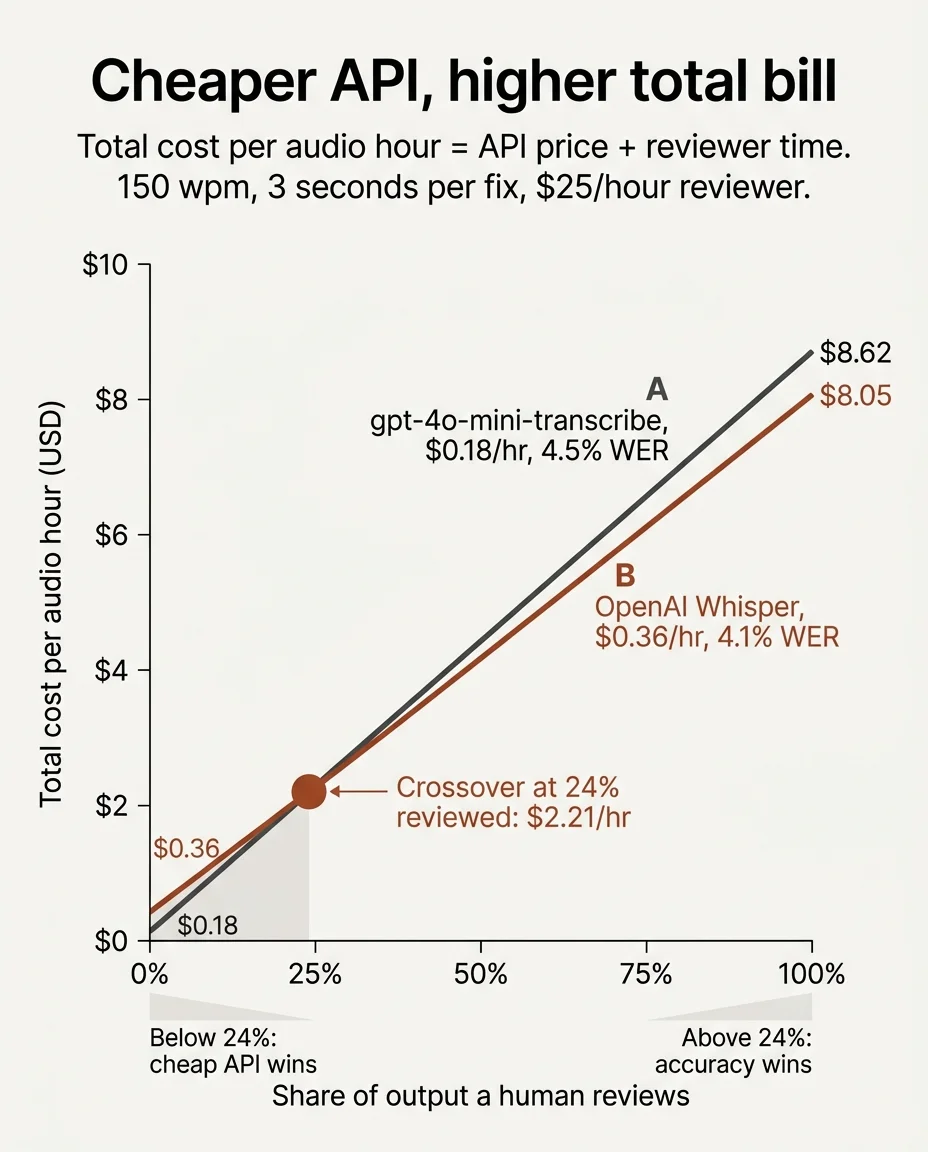
This is why sticker price ranking and true cost ranking disagree. gpt-4o-mini-transcribe costs half what Whisper costs, $0.18 against $0.36, and posts a worse error rate, 4.5% against 4.1%. If nobody reads the output, the mini model wins on every axis that exists. If a reviewer checks more than about 24% of what comes back, the extra errors cost more than the saved API fee and Whisper becomes the cheaper choice. Below that threshold, buy cheap. Above it, buy accurate.
The threshold is brutal when the accuracy gap is wide. AssemblyAI Universal-2 undercuts ElevenLabs Scribe v2 on price, $0.15 against $0.22, but carries 3.8% error against 2.2%. Reviewing just 3% of your output is enough to flip the ranking. There is almost no realistic workflow where the cheaper one wins.
The same trap shows up whenever a headline rate looks too good, which is the argument made at length in what DeepSeek actually costs: the meter is only the part of the price the vendor controls.
Cheaper hosting of the same weights
Whisper is open weight, so OpenAI is not the only place to run it. Groq lists whisper-large-v3 at $0.111 per hour of audio and whisper-large-v3-turbo at $0.04 per hour, checked on 15 August 2026. That is Whisper at between a third and a ninth of OpenAI’s price, on a newer checkpoint than the one the leaderboard benchmarks.
What I cannot tell you is how those two score on the same benchmark, because neither appeared in the leaderboard I read. large-v3 is a different checkpoint from large-v2, and turbo is a distilled decoder, so it is not safe to reuse the 4.1% figure for either. If you are considering the swap, run 30 minutes of your own audio through both and count the errors yourself. That test costs you about eight cents.
Self-hosting on your own GPU is the other route, and it is the one where I have no verified number to give you. The break-even depends on your GPU hourly rate, your utilization and how much engineering time you are willing to not count. I did not price a GPU hour on 15 August 2026, so I am not going to pretend to know where that line sits.
Which meter to buy, by workload
If nothing human reads the transcript, a search index, a topic classifier, an internal archive, buy the cheapest thing that works: Groq whisper-large-v3-turbo at $0.04 per hour, or gpt-4o-mini-transcribe at $0.18 if you want it on the same invoice as your text models, for as long as it lasts: OpenAI removes it on 26 February 2027. For comparison with other options like an hour of live voice, these remain among the most cost-effective solutions available.
If the transcript is published, subtitled or quoted, buy accuracy: ElevenLabs Scribe v2 at $0.22 per hour and 2.2% error is both cheaper and better than the Whisper endpoint, and the review time it saves dwarfs the difference either way.
If you are already inside OpenAI and want the smallest possible change, move from Whisper to gpt-transcribe. It is $0.27 against $0.36 and 3.3% against 4.1%. If you need speaker labels, gpt-4o-transcribe-diarize is $0.36 per hour and saves you bolting a diarization step on yourself, but it is retired on 26 February 2027 as well, so check that the replacement covers speaker labels before you build a pipeline around it.
One more option worth pricing: send the raw transcript through a cheap text model to clean up punctuation and obvious mishearings before the human sees it. At the rates in the GPT-5.2 pricing breakdown, a 9,000 word transcript is a rounding error in tokens, and it can cut review time more than switching transcription vendors does.
What I checked and what I did not
Checked on 15 August 2026, on the vendor’s own pricing page: OpenAI audio rates, Deepgram pre-recorded rates, AssemblyAI async rates, the ElevenLabs Scribe v2 rate, Groq Whisper rates. Checked on the Artificial Analysis AA-WER v2 leaderboard the same day: every word error rate quoted here. The screenshot above is OpenAI’s own grid as it rendered that day, timestamped in the image so it cannot be mistaken for a current one later.
Not checked, and therefore not asserted: Microsoft’s own published rate for MAI-Transcribe-1.5, any negotiated or enterprise discount at any vendor, Google Cloud Speech-to-Text, Rev, Speechmatics, GPU hourly costs for self-hosting, and the accuracy of the two Groq Whisper checkpoints. Prices move, and so do models: the retirement dates in this article were read on OpenAI’s deprecations page on 27 October 2026. If you are reading this months from now, re-check the two or three that matter to you before you commit.
Frequently asked questions
How much does Whisper cost per hour of audio?
$0.36. OpenAI bills $0.006 per minute, and an hour is 60 of them, read from the pricing page on 15 August 2026. A hundred hours of interviews therefore costs $36.
Is Whisper the cheapest transcription API?
Not always. Groq and Deepgram undercut it on their published rates, and the gap only matters at volume: on ten hours a month the whole decision is worth a few dollars.
Does the price change with the language or the audio quality?
The published rate does not. What changes is the accuracy you get back, and correcting a bad transcript costs more in time than any of these APIs cost in dollars.
Do I pay for silence?
Yes. Billing is by minute of audio submitted, not by minute of speech detected, so trimming dead air before upload is the one lever that reduces the bill without touching the rate.