An LLM cost calculator is only worth using if it turns a workload you can actually describe into the invoice each model would produce. The calculator above takes your requests per day, the tokens going in and out of one typical request, the share of input you serve from cache and the reasoning overhead you expect, then ranks twelve models on rates read from each provider’s own pricing page on 14 August 2026, with the two DeepSeek rows re-read on 12 September 2026 and the xAI and Mistral cache rates on 26 September 2026.

Output tokens dominate the result almost everywhere, and reasoning tokens inflate that side of the bill without ever appearing in the answer your users read. The sections below explain the formula, the grid it runs on, and the costs it deliberately leaves out.

Estimate your monthly LLM bill
Describe one typical request and how often you run it. Every rate used below was read from the provider's own pricing page on 14 August 2026, standard tier, per million tokens, with the DeepSeek rows re-read on 12 September 2026, the xAI and Mistral cache rates on 26 September 2026, and the GLM row on 6 October 2026, when GLM 5.3 had replaced GLM 5.2 at the same rates.
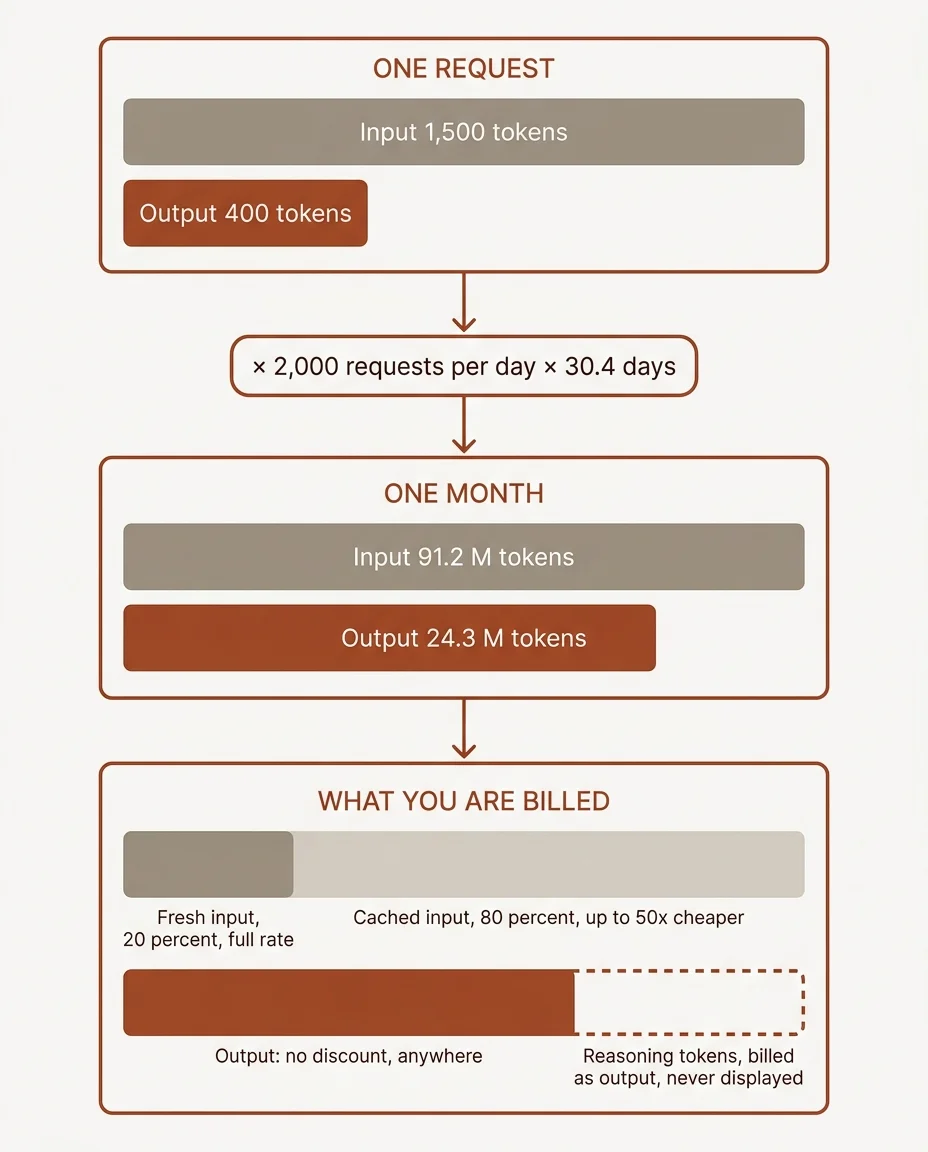
A month is counted as 30.4 days. Reasoning tokens are billed as output even though you never see them, so raising that setting inflates the output side only. Cached input is charged at each provider's own cache read rate, and all twelve models in the grid publish one. The grok-4.6 cache rate used here is the one that applies below 200,000 prompt tokens.
How the calculator turns a workload into a monthly bill
The formula behind the number
The arithmetic is short enough to check by hand. Requests per day times 30.4 gives your monthly request count. Multiply that by the input tokens per request to get your monthly input volume, and by the output tokens per request to get your monthly output volume.
The input volume is then split in two: the cached share is billed at the provider’s cache read rate, the rest at the standard input rate. Output is billed at the output rate with no discount anywhere in the grid, which is precisely why it ends up governing the total.
Every one of the twelve rows has a published cache read rate, and the calculator uses the provider’s own. Two of them were corrected on 26 September 2026. xAI bills cached input on grok-4.6 at $0.50 per million, a quarter of its fresh input rate, on prompts below 200,000 tokens; Mistral bills cached tokens at ten percent of the input rate, which puts Mistral Large 3 at $0.05. Our 14 August 2026 reading found no cache line for either provider, and that reading was wrong: both rates sit in provider documentation rather than on the marketing pricing page we read that day.
Why it asks for requests instead of millions of tokens
Nobody knows their monthly token volume before they have an invoice. Everybody knows roughly how many requests a day their application handles and roughly how long a prompt and an answer are. Asking for the workload in those terms means you can fill the form from your product analytics rather than from a billing dashboard you do not have yet. The calculator shows you the derived token volumes in its summary line so you can sanity check the conversion, and so you can carry those two numbers over to the per-million grid if you want to price a model that is not listed here.
One rule of thumb helps if you are estimating from text rather than from a tokenizer: English prose runs at roughly 0.75 words per token, so a 1,000 word document is around 1,300 tokens. Code, JSON and non-Latin scripts are denser and cost more tokens for the same visible length.
The price grid the calculator runs on
Every rate below was read from the provider’s own pricing page on 14 August 2026, standard tier, in dollars per million tokens, with the two DeepSeek rows re-read on 12 September 2026 and the xAI and Mistral cache rates re-read from provider documentation on 26 September 2026. We checked OpenAI, Anthropic, xAI, DeepSeek and Mistral directly and archived a screenshot of each grid on the day we read it. The GLM row is published by Z.ai rather than by Mistral. It carried GLM 5.2, whose two rates were confirmed against Z.ai’s own listing on 15 August 2026; GLM 5.3 has since replaced it at the same input, cached and output rates, re-read on Mistral’s pricing documentation on 6 October 2026.
We did not check Google, AWS Bedrock, Azure OpenAI or Groq for this page, so no figure for those providers appears in the calculator. The same twelve rows carry the full per-million-token comparison, with the context windows and the long-context tiers spelled out.

| Provider | Model | Input | Output | Cached input |
|---|---|---|---|---|
| OpenAI | gpt-5.6-cyber | $12.50 | $75.00 | $1.25 |
| OpenAI | gpt-5.6-sol | $4.00 | $20.00 | $0.40 |
| OpenAI | gpt-5.6-terra | $2.00 | $12.00 | $0.20 |
| OpenAI | gpt-5.6-luna | $0.20 | $1.20 | $0.02 |
| Anthropic | Claude Fable 5 | $10.00 | $50.00 | $1.00 |
| Anthropic | Claude Opus 5 | $5.00 | $25.00 | $0.50 |
| Anthropic | Claude Sonnet 5 | $2.00 | $10.00 | $0.20 |
| xAI | grok-4.6 | $2.00 | $6.00 | $0.50 |
| DeepSeek | V4.1-Flash | $0.30 | $1.20 | $0.006 |
| DeepSeek | V4-Pro | $1.32 | $3.96 | $0.044 |
| Mistral | Mistral Large 3 | $0.50 | $1.50 | $0.05 |
| Z.ai | GLM 5.3 | $1.40 | $4.40 | $0.14 |
One rate in that table carried an expiry, and no longer does. Anthropic launched $2.00 and $10.00 on Claude Sonnet 5 as introductory pricing through 31 August 2026, then confirmed that the increase to $3.00 and $15.00 planned for 1 September will not happen: both figures are now the standard price, read on the Anthropic pricing page on 16 August 2026.
The spread between the two ends of that table is the reason a calculator beats intuition. On a support workload of 2,000 requests a day, 1,500 input tokens and 400 output tokens each with most of the input cached, DeepSeek V4.1-Flash lands near thirty-five dollars a month while gpt-5.6-cyber lands above two thousand. No amount of careful engineering elsewhere in your stack moves a number by that factor.
The three settings that move your total
Output length per request
Output is where your money goes. Providers in this grid charge between two and six times more for output than for input, and nothing discounts it. Halving the average answer length halves most of your bill, which is why a maximum token limit and a prompt that asks for brevity are the cheapest optimizations available to you. If you have never measured your real average output length, measure it before you trust any estimate: teams routinely guess low by a factor of two.
Cache share
Cached input is billed at a fraction of the standard rate, and the discount is nowhere near uniform: ten times less at OpenAI and Anthropic, ten times less on Mistral Large 3 and on GLM 5.3, four times less on grok-4.6, fifty times less on DeepSeek V4.1-Flash, thirty times less on V4-Pro. It applies to anything you send again on the next call: a system prompt, a tool schema, a document you keep in context. Set the cache share to eighty percent in the calculator and the ranking reshuffles, because models with aggressive cache pricing climb past models with better headline rates. The mechanics differ between vendors, and how Anthropic bills cache writes and cache reads is worth reading before you assume the discount is free: writing to the cache costs more than a normal input token, so a prompt that changes on every call can cost you more with caching enabled than without.
Reasoning overhead
Reasoning models generate tokens internally before writing the answer, and those tokens are billed as output at the full rate. This is the single most common surprise on a first invoice. You measure the length of what your users see, you multiply by the output price, and the real bill arrives two or three times higher. The reasoning setting in the calculator multiplies your output volume rather than adding a separate line, which is exactly how the providers bill it.
What this calculator does not price
The estimate is a standard-tier estimate, and several real costs sit outside it:
- Long context surcharges. Several providers move to a higher rate once a request crosses a context threshold. OpenAI takes gpt-5.6-sol from $4.00 to $8.00 on input and from $20.00 to $30.00 on output in that tier, read on 5 September 2026.
- Batch and off-peak discounts. Work that can wait is cheaper almost everywhere, typically around half price. DeepSeek publishes explicit off-peak hours, which is unusual and worth designing around if your workload tolerates delay. See what DeepSeek actually charges for the detail.
- Retries and failed calls. A timeout that you retry is billed twice. At a two percent retry rate this is noise, at a fifteen percent rate it is a line item.
- Embeddings, moderation and image inputs. Priced separately by every provider and not covered here.
- Tax and regional endpoints. Every figure is the published rate before tax, and data residency endpoints usually carry an uplift.
How to check the estimate against a real invoice
Run the cheapest model that passes your accuracy bar for a week on real traffic, then compare the invoice with what the calculator predicted for that same week. If the two are within twenty percent, your input and output assumptions are sound and you can trust the projection at scale. If the invoice is higher, the gap is almost always output volume: either your answers are longer than you assumed, or you enabled a reasoning model, or your retry rate is worse than you think. If the invoice is lower, your cache is working harder than you estimated, which is the pleasant version of being wrong.
Whatever the result, re-run the numbers when a provider ships a new tier. The rates on this page carry the date they were read, so you can tell at a glance how stale the comparison has become rather than trusting a generic update stamp.
Frequently asked questions
How accurate is an LLM cost calculator?
As accurate as the two numbers you feed it: average input tokens and average output tokens per request. The rates themselves are published and exact. The uncertainty lives entirely in your estimate of your own traffic, which is why a one week pilot beats any amount of modeling.
Do reasoning tokens count as input or output?
Output, at the full output rate, on every provider that sells a reasoning model. You are billed for tokens you never see and cannot read, so budget for them explicitly rather than discovering them on the invoice.
Why is the cheapest model not always the right answer?
Because the cost of a wrong answer is not on the pricing page. When a mistake is cheap to catch, the cheap tier wins easily. When a mistake propagates unsupervised through several tool calls, the frontier price is buying you reliability that is hard to replicate for less.
How often do these prices change?
Rarely on existing models, frequently through new ones. Providers tend to leave a published rate alone and ship a cheaper model beside it, so the risk is not that this table becomes wrong but that it becomes incomplete. The exception is a rate with a published end date, which we flag beside the figure rather than let it expire quietly. Claude Sonnet 5 carried one until Anthropic made the introductory price permanent. We re-read the grids whenever a provider announces a tier.