Anthropic publishes more of its Enterprise price than most vendors do: $20 per seat per month plus usage billed at API rates, on an annual contract, read from the Claude plans page on 15 August 2026. That seat price is the same $20 a Team standard seat costs on an annual term, so Enterprise never undercuts Team at equal headcount, it charges the identical seat and then meters every token on top.

The crossover is therefore structural rather than arithmetic: Team is sold from 2 to 150 people and bundles an allowance Anthropic does not publish in tokens, while Enterprise unbundles that allowance into a line you can price to the cent. Below is the arithmetic, and an honest list of the numbers that only appear in a quote.

What Anthropic publishes about Enterprise, and what it does not
The phrase “contact sales” has trained everyone to assume enterprise AI pricing is a black box. For Claude it is a grey one. The headline number is on the public page, the modifiers are not, and the difference between those two categories is worth more to a buyer than another comparison table.
Claude Enterprise seats, billed on top of API rates
Two Enterprise routes, self-serve and sales-assisted
The plans page splits Enterprise in two. Self-serve Enterprise can be bought the same afternoon with a card, no call required. Sales-assisted Enterprise is the traditional route and is the only one that carries an MSA, non-standard terms, trials, purchase-order invoicing, AWS Marketplace availability and, in Anthropic’s own wording, tiered incentives on committed spend. Both routes are annual. Both carry the same published $20 seat.
That split matters because it tells you when a call is pointless. If you want SSO, SCIM, audit logs and a 500,000 token context window for a department of sixty, you can have all of it today at a published price without speaking to anyone. The call is for the terms, not the features.
The numbers you can price to the cent
Four figures on that page are firm. Enterprise seats are $20 per person per month. Usage on top bills at standard API rates, which as of 15 August 2026 means $5 and $25 per million input and output tokens on Claude Opus 5, $2 and $10 on Claude Sonnet 5, $1 and $5 on Claude Haiku 4.5, and $10 and $50 on Claude Fable 5. Enterprise is billed annually and only annually. The default model runs at a 500,000 token context on Enterprise against 200,000 on Team.
A fifth number is firm but lives elsewhere: Anthropic’s help center states that Enterprise plans require a minimum of 20 seats, read 15 August 2026. The plans page does not mention it, which is why the floor surprises people who priced the plan from the marketing page alone.
Every figure on this page is built from those. Nothing here depends on a number we could not read off a public page.
What only shows up in a quote
Two things stay behind the sales conversation, and pretending otherwise would be dishonest. First, the size of the discount off API rates that a committed-spend tier unlocks: Anthropic confirms tiered incentives exist for sales-assisted customers but publishes neither the tiers nor the discounts. Second, the spend threshold at which dedicated customer success support switches on. We looked for both and found neither published.
There is a further omission that cuts across every plan on the page: Anthropic publishes no token equivalent for what a Pro, Max or Team seat actually includes. Usage limits are described in relative terms, five times a Pro session, five times a standard seat, on a rolling five hour window. That is enough to rank the plans and not enough to price them. It is the single reason a seat-versus-API crossover cannot be computed exactly in one direction.
The seat line across the three routes
Strip out usage for a moment and compare the three routes on the seat alone. The spread is much narrower than most procurement decks assume.
Individual subscriptions at $17 a seat
Claude Pro is $17 per month on an annual subscription, invoiced as $200 up front, or $20 if billed monthly. Bought one card at a time for forty people, that is $680 a month, and it is the cheapest per-head route on the page. What it does not include is anything an administrator needs: no SSO, no domain capture, no central billing, no admin control over connectors, no usage analytics.
The premium for fixing that is $3 per seat per month, the gap between a Pro seat and either a Team or an Enterprise seat on annual terms. At a hundred people that is $300 a month, $3,600 a year, to consolidate a hundred credit cards into one invoice and put SSO in front of the lot. Framed that way it is rarely the expensive part of the decision.
Claude Max sits awkwardly in this comparison. The page lists it as “From $100” per month and offers a choice of 5x or 20x Pro usage, but it does not break out a separate price for the 20x tier. We are not going to guess it.
Team standard and premium seats
Team is sold for organizations of 2 to 150 people. A standard seat is $20 per seat per month billed annually, $25 monthly. A premium seat, carrying five times the standard usage, is $100 per seat per month billed annually, $125 monthly. The two can be mixed inside one organization, which is the plan’s best feature: you buy premium seats for the four people living in Claude Code all day and standard seats for everyone else.
Team brings SSO, central billing, admin controls for connectors, enterprise search across the organization, and no model training on your content by default. It does not bring SCIM, audit logs, a compliance API, role-based access, custom data retention, IP allowlisting or the HIPAA-ready offering. That list, not the price, is what pushes companies onto Enterprise.
Enterprise at $20 plus tokens
An Enterprise seat is $20 per person per month, identical to a Team standard seat on annual terms, and it buys the whole security and administration column: SCIM provisioning, audit logs, the compliance API, fine grained role-based access, custom data retention controls, network-level access control, IP allowlisting, a HIPAA-ready offering and the 500,000 token context window. Payment moves to invoicing with net terms rather than a card.
Then the usage arrives as a separate line, billed at API rates. This is the part that surprises people who read the seat price and stopped there. On Enterprise the seat buys access and governance. The tokens are a metered utility bill.
The usage line, billed at API rates
Because Enterprise usage bills at published API rates, the entire model pricing grid becomes your internal cost sheet. That is unusual and genuinely useful: your finance team can forecast a Claude bill with the same spreadsheet a developer uses to forecast an API bill.
The grid your Enterprise usage bills against

Output is what moves the number. On Claude Sonnet 5 a million output tokens costs five times a million input tokens, and on Opus 5 the ratio is the same at a higher base. Anything that makes Claude write more, longer answers, verbose agent loops, unbounded tool output, hits your Enterprise bill five times harder than anything that makes it read more. The full cross-provider picture is in our LLM API pricing comparison, and the same output-dominates rule holds across every vendor on it.
Three surcharges also sit outside the token grid and land on the same invoice: web search at $10 per thousand searches, code execution at $0.05 per hour per container beyond fifty free hours a day per organization, and managed agent runtime at $0.08 per session-hour, all three read from the same pricing page on 15 August 2026. On a heavy agent deployment those are not rounding errors.
A worked month on forty seats
Take forty people, annual terms, all usage on Claude Sonnet 5, each person running eight million input tokens and one and a half million output tokens a month. Individual Pro subscriptions cost 40 x $17, or $680. Team standard seats cost 40 x $20, or $800. Enterprise costs the same $800 in seats, plus 8 x $2 plus 1.5 x $10, which is $31 of usage per person, or $1,240 across the team. Enterprise total: $2,040 a month.
Enterprise is two and a half times the Team plan and three times a pile of Pro subscriptions, at the same headcount, for the same model. No negotiation changes the shape of that. What changes it is whether those forty people would have hit the Team cap around day eighteen.
Caching is the lever a Team seat does not have
Here is the compensation. Because Enterprise usage bills at API rates, prompt caching applies to it, and cache reads cost a tenth of base input: $0.20 per million on Sonnet 5, $0.50 on Opus 5. Rerun the same month with eighty percent of input served from cache and the usage line falls from $1,240 to $779, taking the total from $2,040 to $1,579. That is a 23 percent cut on the whole bill from one engineering decision.
No equivalent lever exists on Team or Pro, where usage is a black box you cannot optimize because you cannot measure it. The mechanics, including the two separate cache write prices and the clock that invalidates a prefix, are covered in our breakdown of Claude API pricing with cache included.
Where the crossover actually falls
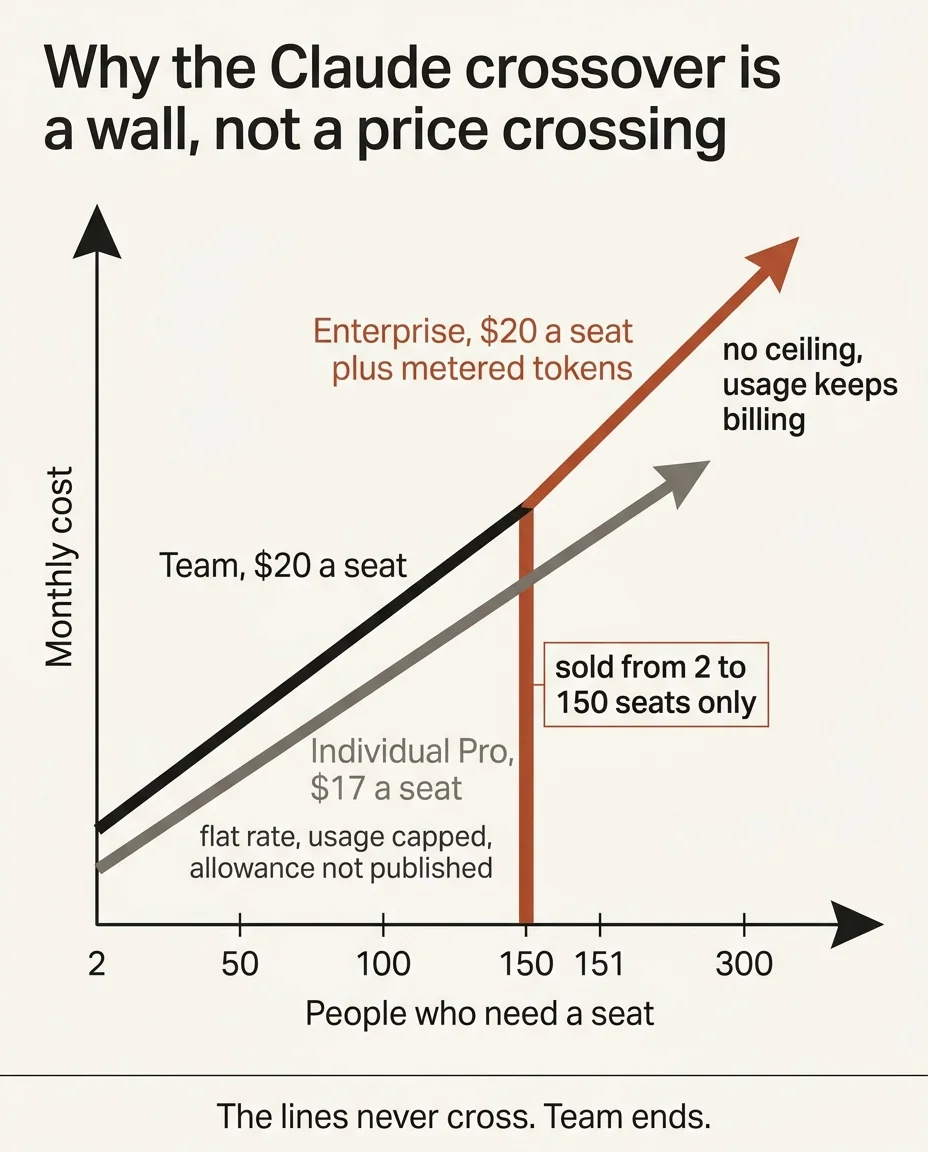
Put the three routes on one axis and the answer stops looking like a price comparison. Two of the lines are flat and end abruptly. One slopes and never ends.
The 150 seat wall
The hard crossovers on headcount are not prices at all, they are availability, and there are two of them. The visible one is at 151 people. Below it Team is available and cheaper; at 151 Team is simply not sold, and the choice collapses to scattered individual subscriptions or an Enterprise contract. That is the reason most Enterprise conversations start where they do.
The other wall sits at the bottom of the range and is easier to miss: Enterprise requires a minimum of 20 seats. From two to nineteen people Team is the only managed route on offer, whatever the token arithmetic says, and Enterprise does not enter the comparison at all. Both plans are genuinely on sale only in the band from 20 to 150 seats.
A premium seat against a metered one
Inside the Team range there is a second, softer crossover worth doing on paper. A Team premium seat costs $100 a month annually against $20 for an Enterprise standard seat, a difference of $80. Eighty dollars of Sonnet 5 usage buys eight million output tokens; on Opus 5 it buys 3.2 million. So a premium seat only pays for itself against a metered Enterprise seat if that person genuinely burns more than roughly eight million Sonnet output tokens a month, and whether the premium allowance would even cover that volume is exactly the thing Anthropic does not publish. Treat this one as a bounded estimate, not a verdict.
When no seats at all is the right answer
If the people who need Claude are developers shipping it inside a product, seats may be the wrong purchase entirely. Raw API access carries no per-person fee, and the usage line is identical to the one an Enterprise contract would meter. What you give up is the chat apps, the admin console, SSO and the governance column. A common and sensible arrangement is both: Team or Enterprise seats for the people who talk to Claude, a Console organization for the code that calls it.
Frequently asked questions
Is Claude Enterprise pricing public?
Partly. The seat price of $20 per person per month and the rule that usage bills at API rates are both published on the Claude plans page, read 15 August 2026. What is not published anywhere is the discount attached to a committed-spend tier and the spend threshold for dedicated customer success. The 20 seat minimum is published, though not on that page: it sits in the help center.
Does Enterprise ever cost less than Team?
Not on published prices at equal headcount and equal annual terms, because the seat costs the same $20 and the tokens are added on top. Against Team billed monthly at $25 a seat the Enterprise seat line is lower, but Enterprise is annual only, so that is not a like-for-like comparison. A negotiated sales-assisted rate could in principle go lower, and Anthropic does not publish it.
Is there a minimum seat count on Enterprise?
Yes, twenty. The plans page says nothing about it, but Anthropic’s help center states that Enterprise plans require a minimum of 20 seats, read 15 August 2026. Team by contrast is sold from 2 to 150 people, so below twenty seats the Team plan is the only managed route available.
Can an Enterprise plan be billed monthly?
No. Anthropic’s own billing FAQ states that Enterprise plans are only available as annual subscriptions, while Pro and Team can be either. Monthly flexibility is one of the things you trade away.
How often is this page re-checked?
Every price here carries the date it was read. We re-read the Claude plans page each time a model or a tier changes, and the date in the text is updated with it. If a figure on this page is older than the one you see on Anthropic’s site, trust theirs and tell us.