The OpenRouter comparison view is accurate on price and silent on route. On 14 August 2026 its catalog rates matched the provider grids to the cent on seven of the eight models where both sides published a rate, so the interface is not hiding a markup.

What it hides is which host serves you: on DeepSeek V4-Pro the default route charged $1.168 per million input tokens against $0.435 on the DeepSeek endpoint listed on the same page, and one OpenAI flagship was not in the catalog at all. The comparator below prices the three paths on your own monthly volume.

OpenRouter route comparator
Pick a model, enter your monthly volume, and see the three prices the comparison view flattens into one: the provider grid, the OpenRouter default route, and the same model with the provider endpoint pinned. Every rate below was read on 14 August 2026.
Rates per million tokens, standard tier, read on 14 August 2026 from each provider pricing page and from the OpenRouter model catalog the same day. Cached input, batch tiers and long-context tiers are billed separately and are not modeled here. With your own provider key the provider bills the tokens at its own grid rate, so the default-route premium only applies to usage funded with OpenRouter credits.
What the OpenRouter comparison view shows, and what it collapses
The model list does one job well. It puts several hundred models on a single page with a price per million tokens next to each, and we counted 411 entries when we pulled the full catalog on 14 August 2026. For a first pass that view is enough, which is why most people never look past it.
The trouble starts when you read a row as a product. A row is not a model. It is a model name with a price attached to whichever host sits first in the routing order that day, and the two are not the same thing.
One model name, many endpoints
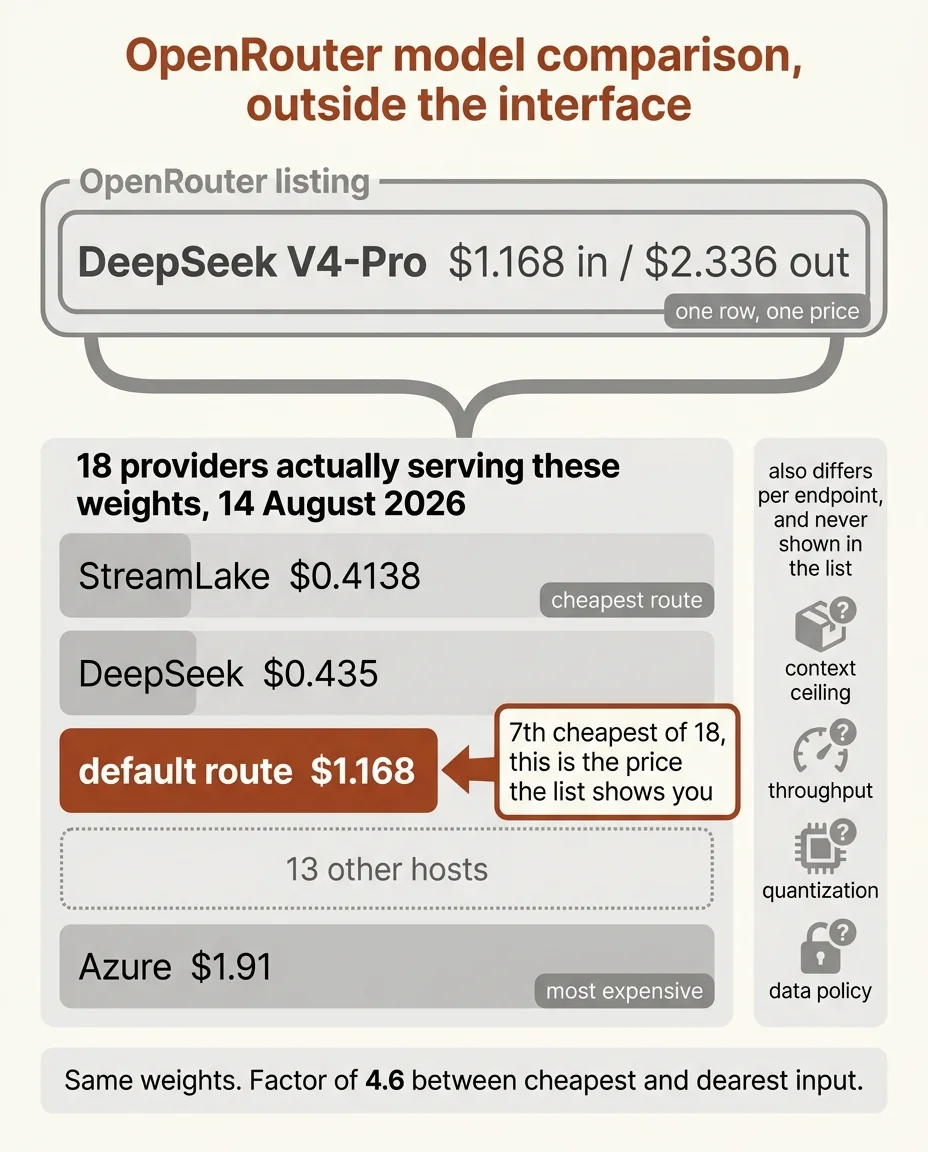
Behind most open-weight models sit several independent providers. Each one sets its own rate, its own context ceiling, its own throughput, and its own policy on what it does with your prompts. OpenRouter does expose them: open the model page and the provider list is there. The comparison view does not, because it has one cell to fill and there are a dozen answers.
DeepSeek V4-Pro had eighteen hosts serving it on the day we looked. Eighteen prices, eighteen sets of behavior, one row in the list.
The default route is a preference, not a ranking
The natural assumption is that the default endpoint is the cheapest one. It is not. On 14 August 2026 the default route for DeepSeek V4-Pro sat seventh cheapest out of eighteen. Routing balances uptime, latency and throughput against price, which is defensible engineering, and an expensive default if nobody ever told you it was a choice.
Where the catalog matched the provider grids to the cent
Before the criticism, the part that holds up. We compared the OpenRouter listing line by line against the pricing page of each provider, both read on 14 August 2026, and on seven of the eight models where both sides published a rate the input and output rates were identical. The eighth is GLM 5.2, and it went the other way, which gets a section of its own further down.
That parity is dated 14 August 2026 and it has not survived the autumn. By 5 September 2026 OpenAI had cut gpt-5.6-sol to $4.00 and $20.00 and DeepSeek had raised V4-Flash to $0.44 and $1.32, while the OpenRouter catalog read on the same day still showed neither move. DeepSeek has moved once more since: on 12 September 2026 the cheap tier is V4.1-Flash at $0.30 and $1.20, and the two older Flash model names are retired. The table below is therefore a record of what the two pages said in August, not a claim about what they say today.
| Model | Input | Output |
|---|---|---|
| gpt-5.6-sol | $5.00 | $30.00 |
| Claude Fable 5 | $10.00 | $50.00 |
| Claude Opus 5 | $5.00 | $25.00 |
| Claude Sonnet 5 | $2.00 | $10.00 |
| grok-4.6 | $2.00 | $6.00 |
| DeepSeek V4-Flash | $0.14 | $0.28 |
| Mistral Large | $0.50 | $1.50 |
The live OpenRouter model list and its rates
Per million tokens, standard tier, same figure on the provider grid and in the OpenRouter catalog, both read on 14 August 2026. The direct side of that reading is the one we publish in our per million comparison of every major model.
So the short answer to the question people actually type is that OpenRouter does not mark up tokens. The money arrives through the credit purchase fee instead: on 14 August 2026 that was 5.5 percent by card with an 80 cent minimum and 5 percent by crypto, which we take apart in what the router adds to your bill.
The line that did not reconcile: cached input
One column refused to line up. DeepSeek prices a cache hit on V4-Flash at $0.0028 per million tokens. OpenRouter listed cached input for the same model at $0.028, ten times higher. We could not tell from the two pages alone whether that is a different cache mechanism, a stale figure, or a real difference in what the routed endpoint charges, so we are reporting the gap rather than explaining it.

grok-4.6 looked like the mirror problem on the day: we found no cached input rate on the xAI pricing page, while OpenRouter listed one at $0.50, so we left the line out of every calculation on this page. The gap was in our reading, not in the router. xAI publishes that rate in its API documentation rather than on its pricing page, at $0.50 per million below 200,000 prompt tokens, re-read on 29 September 2026, and OpenRouter matched it to the cent.
Where the catalog and the grid part company
DeepSeek V4-Pro, eighteen hosts and a factor of four
This is the case that pays for the whole exercise. On 14 August 2026 the default OpenRouter listing for DeepSeek V4-Pro was $1.168 in and $2.336 out. The DeepSeek endpoint, sitting on the same page as one of the eighteen providers serving that model, was $0.435 and $0.87. Across the full list, input ran from $0.4138 at StreamLake to $1.91 at Azure, a factor of more than four for identical weights.
Put a normal workload against that. Fifty million input tokens and ten million output tokens a month, funded with credits bought by card, comes to $86.26 on the default route and $32.12 with the DeepSeek endpoint pinned. That is $54.13 a month, or $649.58 a year, decided by a routing preference and not by anything you asked for. No fee argument about 5 percent survives contact with that number.
GLM 5.2, cheaper through the router than direct
The same mechanism runs the other way, which is why calling routers expensive is as wrong as calling them cheap. GLM 5.2 was listed at $1.19 in and $3.74 out through OpenRouter on 14 August 2026, against $1.40 and $4.40 on the provider grid we read the same day, roughly 15 percent under list. A marketplace prices by whoever is serving you at that moment, and sometimes that is a better deal than buying direct from the vendor.
The models the comparison view cannot show you
The hardest thing to see in a comparison table is an empty row. The OpenAI flagship, gpt-5.6-cyber, was not in the OpenRouter catalog on 14 August 2026. Not throttled, not expensive, not served by a mediocre fallback. Simply absent, with nothing in the interface to mark the absence.
That matters more than any margin if your work depends on a specific frontier model, because a router can only compare what it carries. Before you standardize a stack on one key, check that every model you actually need has a row, and check it again after the next release cycle. Availability on a marketplace is a moving target, and the comparison view is the last place it will be announced.
What we could not verify
Several things on this page are missing, and saying so is cheaper than guessing.
- We did not read the DeepSeek site grid for V4-Pro separately on 14 August 2026, so the comparator leaves the direct column blank on that model rather than borrowing the routed figure.
- We did not check quantization labels, context ceilings or per-endpoint data policies, so we cannot tell you whether a cheaper host was serving reduced precision weights.
- We did not benchmark throughput or latency on any endpoint, and we did not force a fallback to see which host caught it or what it charged.
- Every figure here is one reading on one day. Endpoints join and leave a marketplace continuously, so treat the method as the durable part and the numbers as a snapshot.
How to compare OpenRouter models without trusting the default
The habit that fixes most of this costs about a minute. Open the model page rather than the list, read the provider table underneath, and decide which endpoint you want instead of accepting the one that was picked for you. Where the router supports it, name the provider explicitly or cap the price a route is allowed to reach, so a fallback cannot quietly triple a line item.
Then close the loop in your own logs. Record the provider that actually served each request, not the model string you sent, because on a marketplace those two can differ from one call to the next. A cost per request alert catches a route change long before the invoice does. If the conclusion is that you would rather not manage any of this, the layer itself is replaceable, and we ranked the options in the routers worth switching to.
Frequently asked questions
Does OpenRouter mark up model prices?
Not on tokens. On 14 August 2026 the catalog rates matched the provider grids exactly on seven of the eight models where both sides published a rate, and the eighth, GLM 5.2, came out cheaper through the router than direct. The money arrives elsewhere: on the same date the credit purchase fee was 5.5 percent by card with an 80 cent minimum, 5 percent by crypto, and nothing on your own provider key below $25,000 of monthly usage.
Why is the same model cheaper on another OpenRouter route?
Because several independent hosts serve the same weights and they do not charge the same. DeepSeek V4-Pro ran from $0.4138 to $1.91 per million input tokens across eighteen providers on the day we checked. The listing shows the default route, and the default route is chosen on availability and speed as well as price.
Can you stop OpenRouter from choosing the host?
Yes, that is what the provider routing controls are for: you can name the endpoint you want or set a ceiling on what a route may cost. We did not re-test the parameter names on the day of writing, so take the exact syntax from the current routing documentation rather than from this page.