A per-million-token price tells you almost nothing about your invoice until you multiply it by the shape of your workload. The same 30,000 monthly support conversations cost $55 on DeepSeek V4.1-Flash and $3,180 on gpt-5.6-cyber, and what decides the gap is not the headline rate but how much of your input repeats and how long your answers run.

This page rebuilds three workloads end to end, a support chatbot, a retrieval assistant over your own documents and a batch classifier, and shows the monthly bill each produces on every major model at the rates we read on 14 August 2026, with the DeepSeek line re-read on 12 September 2026 and the xAI cache line on 26 September 2026. Set the volume to yours in the comparator below and the ranking moves with it.
Your monthly bill, workload by workload
Pick the workload that looks like yours, set the volume you run in a month, and read the invoice each model would produce. Every rate below is the provider's published standard tier, read on 14 August 2026, with the DeepSeek rows re-read on 12 September 2026, the xAI and Mistral cache rates on 26 September 2026, and the GLM row on 6 October 2026, when GLM 5.3 had replaced GLM 5.2 at the same rates.
The token count assumed per unit is stated in the article below, so you can adjust the volume to match your own traffic. Reasoning tokens, long-context surcharges, batch discounts and retries are excluded, and every one of them moves the real invoice.
Three workloads, and the invoice each one produces
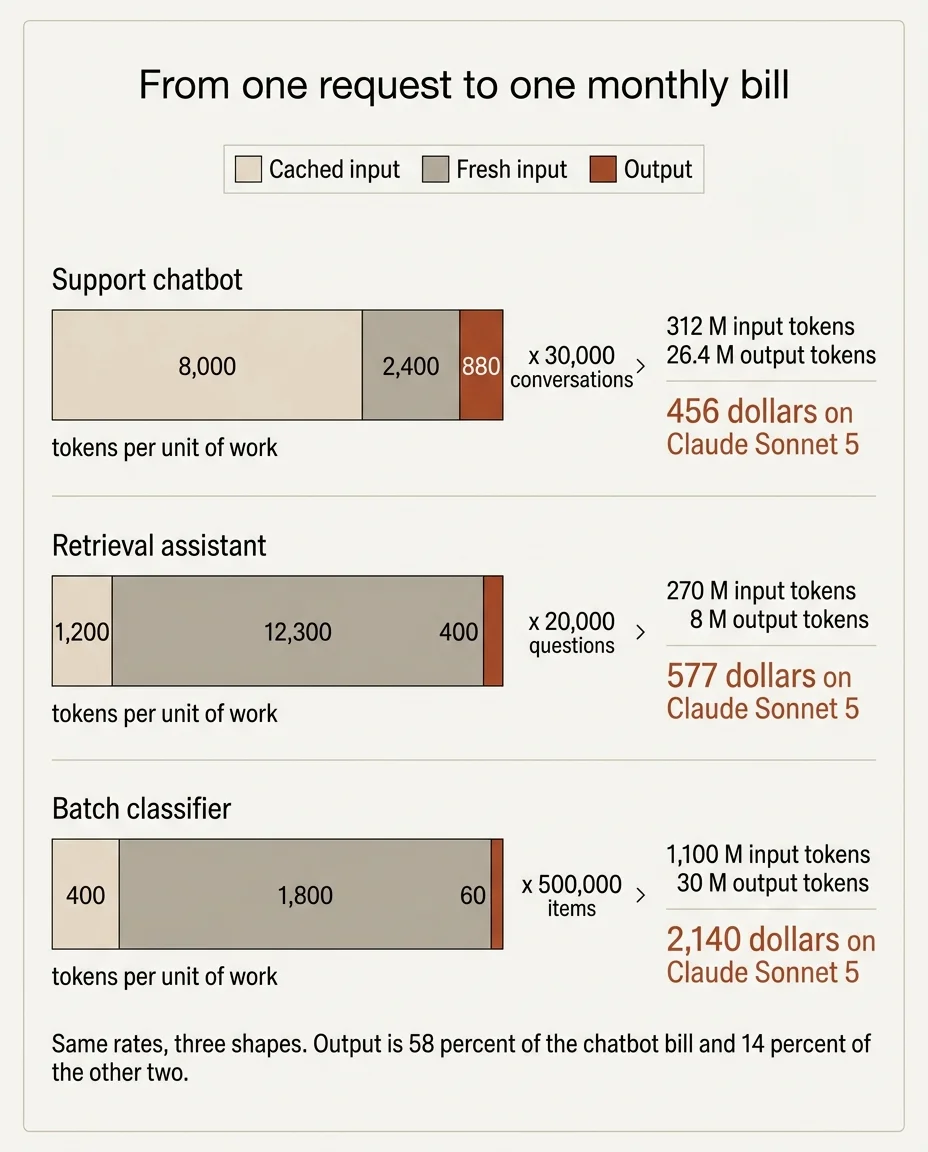
Every figure below rests on a token count per unit of work, stated out loud so you can argue with it and swap in your own. The rates come from the same grid as our per-million comparison of every major model, read from each provider’s own pricing page on 14 August 2026, refreshed on the DeepSeek line on 12 September 2026 and on the xAI cache line on 26 September 2026. Nothing here is an average of what other people pay: it is arithmetic on published rates, and the arithmetic is the point.
The support chatbot, 30,000 conversations a month
Assume four turns per conversation. A system prompt plus the help center snippets you retrieve once and keep in context comes to 2,000 tokens, resent on every turn. Another 600 tokens per turn are genuinely new: the growing conversation history and the customer’s latest message. Each answer runs 220 tokens. That is 10,400 input tokens per conversation, 8,000 of them identical from one call to the next, and 880 output tokens.
At 30,000 conversations, the workload sends 312 M input tokens and 26.4 M output tokens a month, with 77 percent of the input cacheable. Claude Sonnet 5 bills $456, or 1.5 cents a conversation. gpt-5.6-terra lands at $509, Claude Opus 5 at $1,140, gpt-5.6-cyber at $3,180. DeepSeek V4.1-Flash does the same month for $55.
grok-4.6 comes in at $422, just under Claude Sonnet 5, and that figure is a correction. Until 26 September 2026 this page billed all 312 M input tokens at the full $2.00 and put grok-4.6 at $782, because we had read xAI as publishing no cached-input rate. It does publish one, at $0.50 per million, in its API documentation rather than on the pricing page we read on 14 August 2026. On a workload where 77 percent of the input repeats, that single column is worth $360 a month, which is the general lesson rather than a point about xAI: the cache line moves a chatbot bill further than the output rate does.
The retrieval assistant, 20,000 questions over your own documents
Here the shape inverts. Per question: a 1,200 token system prompt that never changes, then 12,300 tokens of retrieved passages and the user’s question, different on every call, and a 400 token answer. Twenty thousand questions a month is 270 M input tokens against only 8 M of output, and just 9 percent of the input repeats.
Claude Sonnet 5 bills $577 a month, of which $497 is input. Output is 14 percent of the invoice. gpt-5.6-cyber reaches $3,705, DeepSeek V4.1-Flash $83. The received wisdom that output drives every LLM bill is a chatbot statement that quietly stops being true the moment you start stuffing documents into the prompt, and retrieval is the most common way teams end up there without noticing.
The batch classifier, 500,000 items a month
Half a million tickets, reviews or documents to label. Per item: a 400 token instruction block, an 1,800 token document, and 60 tokens of output, a label and a one-line justification. Monthly totals are 1,100 M input tokens and 30 M output tokens, 18 percent cacheable.
DeepSeek V4.1-Flash bills $308, or 0.062 cents an item. gpt-5.6-luna comes in at $220, Claude Sonnet 5 at $2,140, gpt-5.6-cyber at $13,750. This is the workload where a frontier model is hardest to defend on a spreadsheet, because the task is narrow, the output is short, and a fortyfold price gap converts straight into a fortyfold invoice. It is also a workload where gpt-5.6-luna undercuts the DeepSeek cheap tier, as it does on the other two, because almost none of this input repeats and luna’s input rate is the lower of the two. It is also the workload most likely to qualify for a batch tier, which typically halves the figures above again.
The per-million rates behind these numbers
Eight of the twelve models the comparator prices, at the standard-tier rates we read on 14 August 2026, with the DeepSeek line re-read on 12 September 2026 and the xAI cache line on 26 September 2026. Every model named in the three workloads above sits in this table, and the full grid sits on the pillar comparison.
| Provider | Model | Input | Output | Cached input |
|---|---|---|---|---|
| OpenAI | gpt-5.6-cyber | $12.50 | $75.00 | $1.25 |
| OpenAI | gpt-5.6-sol | $4.00 | $20.00 | $0.40 |
| OpenAI | gpt-5.6-terra | $2.00 | $12.00 | $0.20 |
| OpenAI | gpt-5.6-luna | $0.20 | $1.20 | $0.02 |
| Anthropic | Claude Opus 5 | $5.00 | $25.00 | $0.50 |
| Anthropic | Claude Sonnet 5 | $2.00 | $10.00 | $0.20 |
| xAI | grok-4.6 | $2.00 | $6.00 | $0.50 |
| DeepSeek | V4.1-Flash | $0.30 | $1.20 | $0.006 |

What we verified: the rates in this table and in the comparator, against each provider’s published pricing page on 14 August 2026, with a screenshot archived on the day, and the xAI cached-input rate against xAI’s API documentation on 26 September 2026. What we did not verify: any discount you may have negotiated, enterprise commitments, regional endpoints priced above the standard tier, and the throughput each provider will actually grant your account. Those move a real invoice and none of them are public.
What actually moves the invoice
Output volume, until the workload turns input-heavy
Providers charge two to six times more for output than for input, because generating a token costs a forward pass while reading one does not. That multiplier is why the chatbot bill is output-dominated: on gpt-5.6-cyber, 26.4 M output tokens cost $1,980 while 312 M input tokens cost $1,200. Twelve times fewer tokens, more money.
The multiplier stops mattering as soon as your input to output ratio passes roughly twenty to one, which is exactly where retrieval and classification sit. At that point trimming answers saves nothing and the only lever left is how many passages you retrieve. Teams who read one blog post about output pricing and go tune their max tokens on a RAG pipeline are optimizing the 14 percent.
The cache share, the one lever you can pull this week
Set the comparator’s cache field to None and the chatbot on Claude Sonnet 5 moves from $456 to $888. On that arithmetic, caching the repeated prompt halves the bill, and it takes no model change, no evaluation campaign and no migration, only that you keep the stable part of your prompt at the front and mark it. A cache hit is billed at a tenth of the base input rate on most grids, a quarter on grok-4.6 and a fiftieth on DeepSeek V4.1-Flash, applied to the cached portion of input only.
What the comparator does not charge you for is the write. Putting tokens into a Claude Sonnet 5 cache costs $2.50 per million against $2.00 for ordinary input, and a five minute entry has to be rewritten every time your traffic goes quiet. Bill each chatbot conversation one write plus three reads and the Sonnet 5 month lands at $594 instead of $456, still a third under the $888 you pay with no cache at all.

The trap is that cache pricing is invisible in every headline comparison, including most of the ones that rank for this query. A model with a mediocre input rate and an aggressive cache rate beats a cheaper model with no cache line on any workload that repeats, and almost every production workload repeats far more than its designers assumed. We broke the mechanism down in detail in what the Claude API costs once caching is counted, including how long an entry survives.
Reasoning tokens you pay for and never read
Reasoning models generate tokens internally before the answer appears, and those tokens bill as output. If you estimate a reasoning workload by measuring the answers your users see, the invoice arrives two to five times higher than your model. The three profiles above assume no reasoning tokens at all. Raise the output figure well beyond the visible answer length before you trust a reasoning estimate.
What these three invoices leave out
Long context is billed at its own rate
Several providers apply a surcharge past a context threshold, and the OpenAI grid above prints it as a second block of columns. gpt-5.6-sol moves from $4.00 to $8.00 on input, from $0.40 to $0.80 on cached input and from $20.00 to $30.00 on output once a request crosses into the long-context tier, at the rates we read on 5 September 2026. A retrieval workload that grows its context window is the classic way to double an input line without changing a single price.
Batch and off-peak windows
Work with no latency requirement is cheaper nearly everywhere. Batch endpoints usually halve the rate, and DeepSeek publishes explicit off-peak hours at roughly half price, which is unusual enough to be worth scheduling around if your classifier can wait. We went through the real cost of that provider in what you actually pay for DeepSeek, off-peak windows included.
Retries, evaluations and the traffic nobody forecast
Production adds a tax the arithmetic ignores. Failed calls that get retried, evaluation suites replaying thousands of prompts on every deploy, a staging environment nobody turned off, and the calls a user makes because your first answer was wrong. Budget a comfortable margin over the comparator, and instrument spend per endpoint before you need to explain a line on the invoice.
Frequently asked questions
How do I get a token count for my own workload?
Log usage from the API responses you already receive. Every provider returns input and output token counts on each call, so a week of production logs gives you a per-request average that is worth more than any estimate on this page. Multiply by your monthly request count and put the result into the comparator.
Does the cheapest model change from one workload to the next?
The bottom of the table barely moves, but the middle reorders substantially. grok-4.6 sits sixth on both the chatbot and the retrieval assistant, one place ahead of Claude Sonnet 5 in each, on a cache read of $0.50 against $2.00 for fresh input. Ranking by headline price alone will mislead you on any workload with a stable prefix.
Will these figures match the invoice I receive?
They will be in the right order of magnitude and wrong in the details. Reasoning tokens, cache writes, retries, long-context surcharges and taxes all sit outside the calculation, and each of them only pushes the number up. Treat the comparator as a floor for the model you pick, not as a forecast.
How often are these rates rechecked?
Whenever a provider changes a grid or ships a model that belongs in the table. Each figure carries the date we read it, and the screenshot taken that day is kept as the record, so you can judge how fresh this page is instead of trusting a generic update stamp.