Since 20 November 2026, OpenAI’s Usage Policies require any service that lets third parties directly access OpenAI models to get OpenAI’s prior review and approval, and an app that only uses GPT for its own features is not concerned. Between Chutes and OpenRouter, only OpenRouter is in scope, because Chutes serves no OpenAI model. DigitalOcean resells GPT access and falls under the same wording, while Hugging Face Inference Providers only routes open-weight models. On 21 November 2026 nothing had moved on the bill: GPT-6.2 Sol still costs $2 in and $10 out on OpenRouter, the same as at OpenAI.

Chutes vs OpenRouter and the other routes, one by one
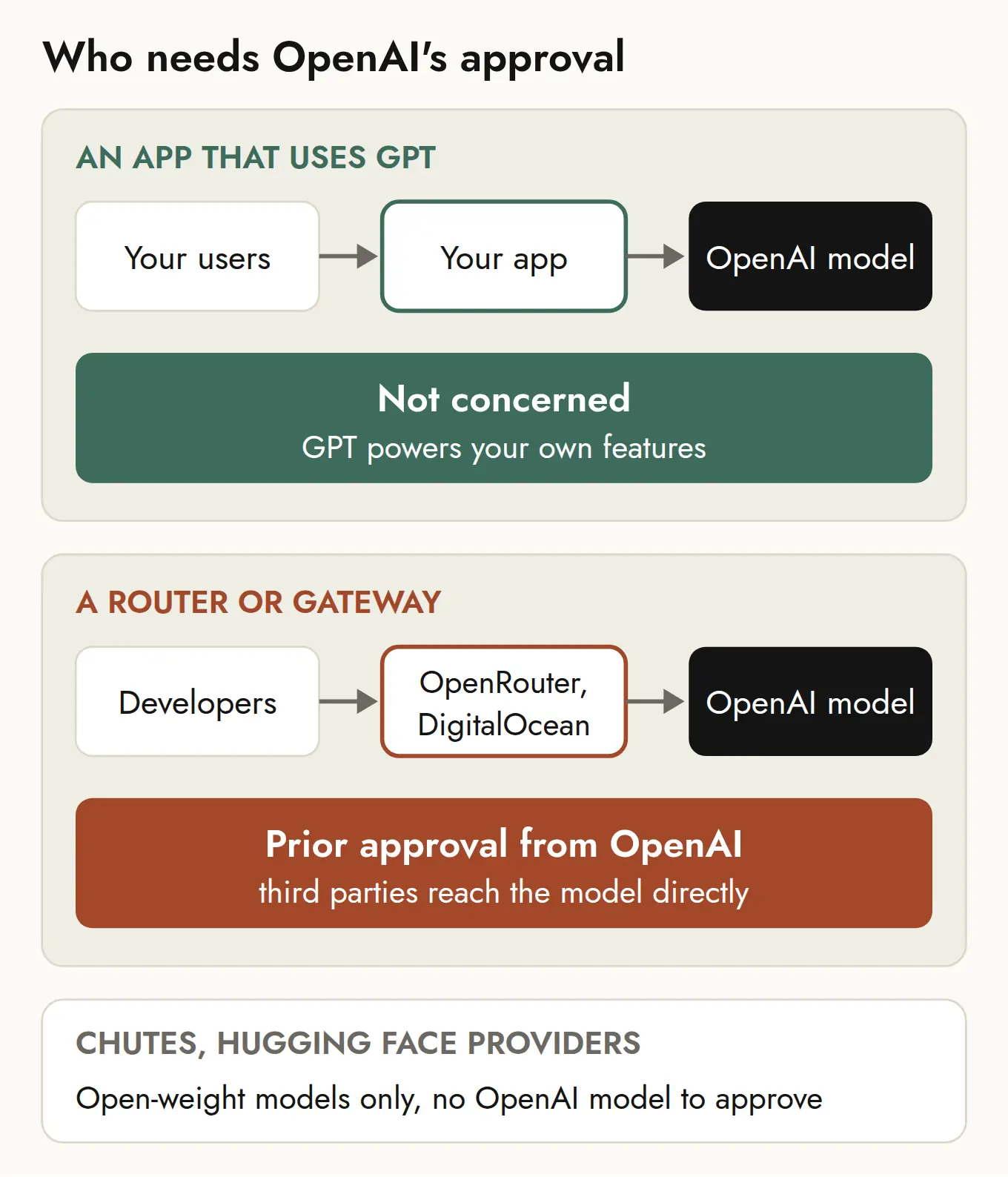
The rule does not name a single company. It describes a type of service, so the only way to know whether your route is affected is to check what it actually sells. For each route, one question decides: does it hand third parties direct access to OpenAI models?
| Route | Where it stands under the rule |
|---|---|
| OpenRouter | In scope: it sells direct API access to 162 OpenAI models |
| DigitalOcean serverless inference | In scope by the wording: it resells GPT models through its own API |
| Chutes | Not concerned: no OpenAI model in its catalog |
| Hugging Face Inference Providers | Not concerned for chat models: open-weight models only, routed through OpenRouter |
OpenRouter, squarely in scope
OpenRouter is the textbook case. Its OpenAI page lists 162 OpenAI models, from GPT-6.2 Astra to the image models, and any developer with an OpenRouter key can call them directly.
Being in scope does not mean being cut off. On 21 November 2026, OpenRouter still routed GPT-6.2 Sol to three providers: OpenAI itself, Azure and Amazon Bedrock. Neither OpenAI nor OpenRouter has said publicly whether that approval has already been granted, and OpenRouter’s blog carries no post on the subject.
DigitalOcean, a reseller of GPT access
DigitalOcean’s serverless inference grid lists GPT-6.2 Astra, GPT-6.2 Sol, GPT-6.1 Sol and older GPT models down to GPT-4o mini, billed on your DigitalOcean account. A developer reaches those models through DigitalOcean’s API, which matches the wording of the rule just as well as OpenRouter does.
The page was updated on 21 November 2026 with the full GPT list still in it. If you weighed the two, my DigitalOcean vs OpenRouter comparison still holds on price: both bill GPT at OpenAI’s list rate.
Chutes and Hugging Face, no OpenAI model to approve
Chutes is where the Chutes vs OpenRouter choice gets simpler. Its pricing page and its OpenRouter provider page list open-weight models only, such as DeepSeek V4.1 Flash, Qwen3.8 27B, GLM-5.3 and Kimi K3, and not a single OpenAI model. My Chutes vs OpenRouter price comparison covers those models, and none of them is touched by this rule.
Hugging Face Inference Providers switched its chat models to OpenRouter’s router on 16 November 2026, but only for open-weight models. Even gpt-oss-120b and gpt-oss-20b, OpenAI’s open-weight models, ship with their own one-line usage policy, which only asks you to comply with applicable law. If you moved there recently, the Hugging Face Inference Providers pricing breakdown is unchanged.
What the new clause actually says
The change is short, and its exact wording decides who is in and who is out.
The two sentences that matter
The clause sits under “OpenAI-approved use” in the OpenAI Usage Policies, effective 20 November 2026. Under the heading “Providing access to our models”, it says that a model-access intermediary platform, or any service that enables third parties to directly access OpenAI models, must obtain OpenAI’s prior review and approval. The next sentence draws the line: the requirement does not apply solely because an application integrates OpenAI models to power its features.
From 20 November 2026, a service that lets third parties directly access OpenAI models needs OpenAI's prior review and approval. An app that only uses GPT to power its own features does not.
The changelog dates the update to 21 October 2026, alongside new rules on training other models with OpenAI outputs and on high-stakes uses.
Hosts and resellers were already in the frame
OpenAI’s announcement, Broad access through consistent standards, published on 21 October 2026, explains the logic. Its safety policies apply whether people reach the models through OpenAI, through partners that host them, or through reseller partners. Those partners must keep safeguards consistent with OpenAI’s own, investigate violations and coordinate on enforcement.
The router clause extends that to the services in between, which the announcement calls model routers and AI gateways.
What has not changed on your bill
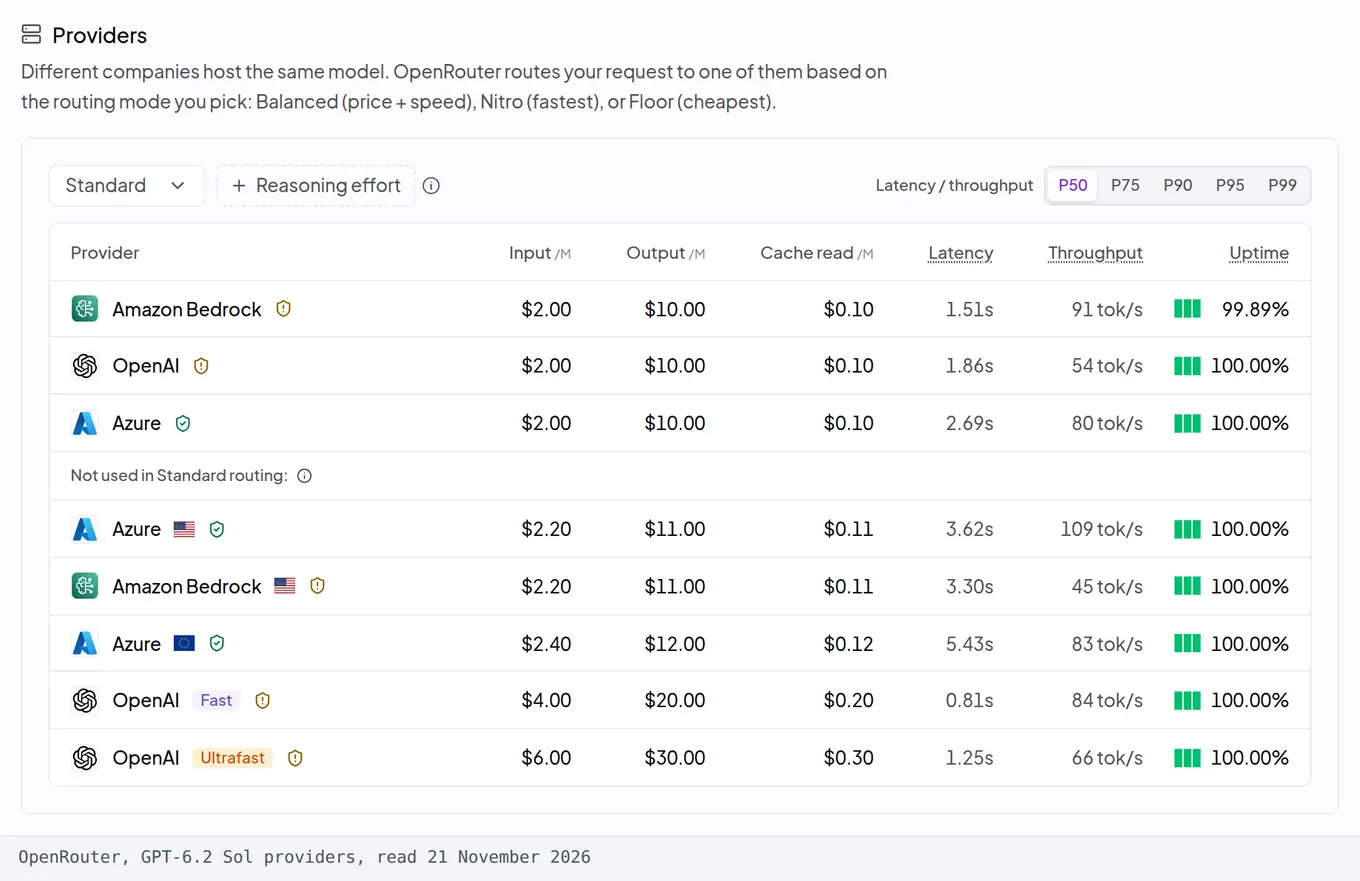
The price did not move. On 21 November 2026, GPT-6.2 Sol cost the same on every route, before any router fee.
| Route for GPT-6.2 Sol | Input / output / cache read per million tokens |
|---|---|
| OpenAI API, Standard | $2.00 / $10.00 / $0.10 |
| OpenRouter, OpenAI, Azure or Amazon Bedrock endpoint | $2.00 / $10.00 / $0.10, plus 5.5% on Standard credit purchases |
| OpenRouter, US-only Azure or Bedrock endpoint | $2.20 / $11.00 / $0.11 |
| DigitalOcean serverless inference, up to 272K tokens | $2.00 / $10.00 / $0.10 |
OpenRouter’s fee sits on the money you load, not on the tokens: 5.5% on Standard and 8% on Business, according to its pricing page. With your own OpenAI key (BYOK), the first $25,000 of list-price inference each month carries no OpenRouter fee, then 5%.
On 21 November 2026, OpenRouter still listed 162 OpenAI models and routed GPT-6.2 Sol to OpenAI, Azure and Amazon Bedrock at $2 in and $10 out per million tokens.
The capture below is OpenRouter’s GPT-6.2 Sol provider table on that date, with OpenAI’s own Fast and Ultrafast endpoints at the bottom.
What OpenAI has not published yet
The policy sets the rule but leaves the procedure blank. Neither the Usage Policies nor the announcement contains what a router user needs to plan with.
- No list of approved routers or gateways, so you cannot check whether yours has been cleared.
- No application process, review criteria or review time for intermediaries.
- No statement on what happens to a service that has not been approved: grace period, throttling or cutoff.
- No word from OpenRouter on its own blog, where the latest posts cover its Hugging Face partnership and access controls.
That gap matters more than the rule itself. OpenAI already paused one model on OpenRouter in December 2024, so a model-level restriction is not a hypothetical.
OpenRouter announced that pause itself: OpenAI told it that o1’s general availability on the router was paused, and the model went BYOK-only “until some time in the new year”.
o1 is temporarily going BYOK-only. OpenAI’s new o1 model going BYOK-only on OpenRouter until some time in the new year. o1-preview and o1-mini are unaffected. OpenAI let us know that they’re pausing o1’s general availability on OpenRouter while they continue a gradual roll
@OpenRouter
https://x.com/OpenRouter/status/1870190670977347858
Are you an intermediary yourself?
If you resell GPT inside a product, the clause can reach you too, depending on what your users actually get.
Your app calls GPT for its own features
A support bot, a writing tool or a coding agent that sends its own prompts to GPT is the case the policy excludes in so many words. No approval is needed, whichever route you buy the tokens through.
You hand out keys or a pass-through endpoint
The picture changes if your customers send their own raw requests to GPT through you, for instance an internal gateway sold to other companies, or an API that forwards prompts unchanged. That is direct third-party access, and the clause asks for OpenAI’s review before you offer it.
The test I would apply is simple: who writes the prompt that reaches the model? If it is your code, you are an app; if it is your customer’s code, you are an intermediary.
Two clauses that follow you on every route
Two other changes in the same update apply whether you buy GPT directly or through a router.
- You may not use OpenAI models or their outputs to build training data, feedback or rankings for models meant to replace OpenAI’s, even through a third party.
- OpenAI is introducing SafetyIDs, identifiers you can pass so that an investigation targets one end user instead of your whole account.
What I would do this week
Nothing on the bill has changed, so there is no reason to migrate. There is every reason to make sure a policy decision at OpenAI cannot take your product down overnight.
- Keep a direct OpenAI API key wired in your own code as a fallback. BYOK on OpenRouter is not a hedge here: your traffic still passes through the router.
- Set a non-OpenAI fallback model in your OpenRouter requests, so a restricted GPT model fails over instead of returning errors.
- If you run a gateway for other teams or customers, treat yourself as an intermediary until OpenAI publishes its review process.
My verdict: for an OpenRouter user calling GPT from an app, 20 November changed nothing you can see today. It moved the risk to OpenRouter’s relationship with OpenAI, and a direct key is the cheapest insurance against it.