DigitalOcean and OpenRouter both bill the model’s own list price per million tokens, so Claude Opus 5.5 costs $4.00 in and $20.00 out on either. The difference sits on top: OpenRouter takes a 5.5% fee on every credit purchase, while DigitalOcean adds nothing for routing. The surprise runs the other way on open models: DigitalOcean’s own endpoint on OpenRouter lists GLM 5.3 at $0.91 vs $1.40 on DigitalOcean direct, cheaper even after OpenRouter’s fee.

Where the price difference actually comes from
Neither platform marks up the token rate on frontier models. Both pass through the provider’s published price, so the bill only diverges on the fees around it. That is where you should look before you compare any model row.
DigitalOcean bills the model and nothing else
DigitalOcean’s inference pricing documentation says serverless prices “align with each provider’s published rates”. The Inference Router, which picks a model per request, is in public preview and costs nothing extra: you pay for the model that served the request.
There is one catch I would flag to any team: serverless inference on DigitalOcean is prepaid only. When your credits and balances run out, access is suspended until you add funds.
OpenRouter adds 5.5% when you buy credits
OpenRouter’s pricing page is explicit: inference is billed at the provider’s list price on every plan, and the fee is charged when you buy credits, never per request. That fee depends on the plan you pick.
- Free: no fee, 25+ free models, capped at 50 requests a day.
- Standard (pay as you go): 5.5% on each credit purchase.
- Business: 8% on each credit purchase, in exchange for EU and US in-region routing and 1,000 workspaces.
- Enterprise: fee discounts by contract. OpenRouter states it does not discount inference itself.
OpenRouter Standard: 5.5% on every credit purchase. Business: 8%. DigitalOcean Inference Router: $0 extra during public preview.
BYOK changes the math on OpenRouter
If you bring your own provider key to OpenRouter, the provider bills you directly. Standard and Business include $25,000 of list-price inference per month through BYOK with no OpenRouter fee, then 5% of what the same request would cost at list price. DigitalOcean also accepts your own Anthropic or OpenAI keys, in which case Anthropic or OpenAI bills you at its own rates.
I break down the rest of the router’s fee schedule, including the free tier limits, in my page on what OpenRouter adds to your bill.
DigitalOcean on OpenRouter undercuts DigitalOcean direct
DigitalOcean is not only an OpenRouter rival. It is also one of OpenRouter’s providers, with 17 models listed on its OpenRouter provider page. OpenRouter announced the listing on 2 June 2026, and the post below carries the speed claim it led with, credited to Artificial Analysis.
⚡ New provider drop: AI-Native Cloud from @digitalocean is now live on OpenRouter. High performance inference across popular open-weight models. #1 on output speed and latency for DeepSeek V3.2 by @ArtificialAnlys. See their stats and try the models: https://t.co/baNXyerJzI https://t.co/Sg91fRVrsV
@OpenRouter
https://x.com/OpenRouter/status/2061840338973806961
Compare the two grids line by line and some rows do not match. Prices below are per million tokens, as of 12 November 2026, from DigitalOcean’s documentation (last verified 10 November 2026) and from OpenRouter’s provider tables for the DigitalOcean endpoint.
GLM 5.3 and DeepSeek V4.1 Flash
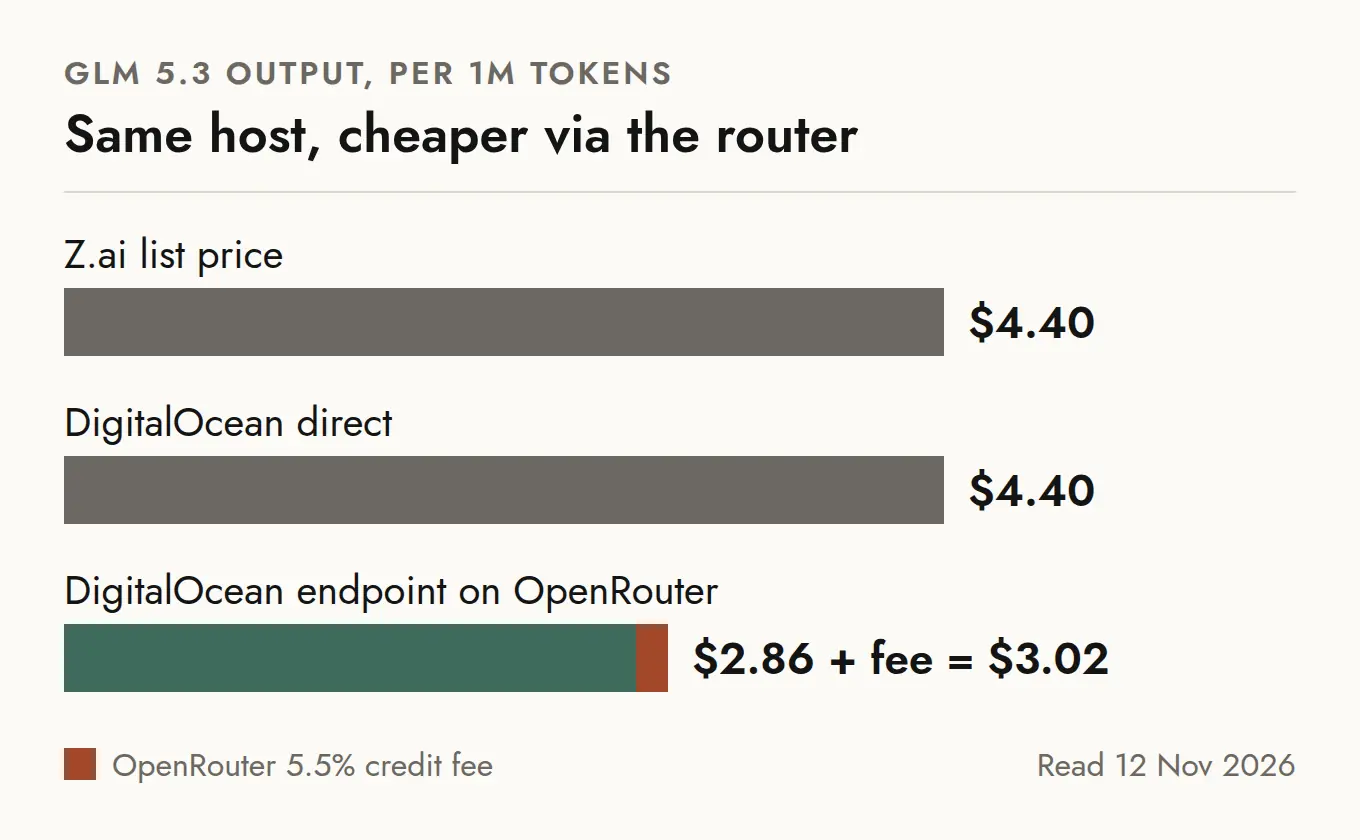
On these two models, DigitalOcean’s endpoint inside OpenRouter is listed well below DigitalOcean’s own serverless rate. The gap is wide enough to survive the 5.5% credit fee. For GLM 5.3 it even beats the lab: DigitalOcean’s direct rate is the $1.40 / $4.40 that Z.ai lists on its own pricing page.
| Model (input / output per 1M) | DigitalOcean direct vs DigitalOcean endpoint on OpenRouter |
|---|---|
| GLM 5.3 | $1.40 / $4.40 direct; $0.91 / $2.86 on OpenRouter (about $0.96 / $3.02 with the 5.5% fee) |
| DeepSeek V4.1 Flash | $0.30 / $1.20 direct; $0.225 / $0.90 on OpenRouter (about $0.24 / $0.95 with the fee) |
| Kimi K3.1 Pro | $2.00 / $10.00 on both |
| DeepSeek V4 Pro 0813 | $1.32 / $3.96 on both |
| MiniMax M3.1 Flash | $0.15 / $0.60 on both |
The GLM 5.3 endpoint on OpenRouter sits at exactly 65% of DigitalOcean’s direct rate, on input, output and cache reads ($0.169 against $0.26). DeepSeek V4.1 Flash sits at 75% on input and output, with the same $0.006 cache read on both. Neither company explains the gap on these pages, so treat it as a listed price that can move, not a policy.
GLM 5.3 through OpenRouter's DigitalOcean endpoint: $0.91 in, $2.86 out. Through DigitalOcean directly: $1.40 in, $4.40 out.
Where the two grids match
Kimi K3.1 Pro, DeepSeek V4 Pro 0813 and MiniMax M3.1 Flash carry the same rate on both doors. On those rows OpenRouter is simply 5.5% more expensive on Standard, because the fee lands on the credits you spend there.
Keep in mind that OpenRouter routes to the provider it picks unless you pin one. The GLM 5.3 page lists dozens of providers, some well below DigitalOcean’s endpoint, so the price you pay depends on your routing settings as much as on DigitalOcean.
Frontier models cost the same, plus or minus the fee
On Claude and GPT, there is no hidden discount on either side. DigitalOcean’s grid matches Anthropic and OpenAI list prices, and OpenRouter shows the same figures from Anthropic, Claude Platform on AWS, Amazon Bedrock, Google Vertex and Azure for Opus 5.5.
| Model (input / output per 1M) | Listed price on DigitalOcean |
|---|---|
| Claude Opus 5.5 | $4.00 / $20.00, cache read $0.20 (same on OpenRouter) |
| Claude Fable 5.2 | $8.00 / $40.00 on DigitalOcean |
| Claude Haiku 5.5 (up to 100K tokens) | $0.10 / $0.50 on DigitalOcean |
| GPT-6.1 Sol (up to 272K tokens) | $2.00 / $10.00 on DigitalOcean |
So on a frontier model, DigitalOcean wins by exactly the OpenRouter fee and nothing more. If you already run on Anthropic or OpenAI directly, neither router saves you money on these rows.
What a month costs on each
Take a workload of 100 million input tokens and 20 million output tokens, with no caching. The arithmetic is short, so here it is in full.
- Claude Opus 5.5 on DigitalOcean: $400 input plus $400 output, $800.
- Claude Opus 5.5 on OpenRouter Standard: the same $800 of tokens, plus 5.5% on the credits, about $844.
- GLM 5.3 on DigitalOcean direct: $140 plus $88, $228.
- GLM 5.3 pinned to DigitalOcean on OpenRouter: $91 plus $57.20, $148.20, about $156 with the fee.
The fee costs you $44 on the Claude month. The listing gap saves you about $72 on the GLM month. Which one matters depends on what you actually run.
What else lands on the bill
Token rates are only part of the invoice. Both platforms charge for a few extras that a quick comparison misses.
Batch and tools on DigitalOcean
DigitalOcean charges batch inference at up to 50% off on OpenAI and Anthropic models, and only bills completed requests. Its web search tool costs $10 per 1,000 requests and web fetch $3 per 1,000, both waived when the model is from Anthropic.
Free models and failed calls on OpenRouter
OpenRouter does not charge model tokens for an attempt that errors, so a fallback only bills the run that answers. Its free models are capped at 20 requests a minute and 50 a day, rising to 1,000 a day once you have bought at least $10 of credits. If the free tier matters to you, my comparison of Chutes and OpenRouter costs covers a cheaper router built around open models.
My verdict on which one to pay
I would not pick between these two on frontier models: same list price, and DigitalOcean only wins by the 5.5% fee. The real decision is about where the rest of your stack lives and which open models you run.
- Pick DigitalOcean if you mostly call Claude or GPT, already host on DigitalOcean, and want one prepaid bill with no router fee.
- Pick OpenRouter if you run GLM 5.3 or DeepSeek V4.1 Flash at volume: pinning DigitalOcean’s endpoint there beats DigitalOcean’s own price, fee included, as of 12 November 2026.
- Pick neither if you need a single provider at the lowest price: go to that provider’s own API, or look at the OpenRouter alternatives worth switching to.