
Anthropic bills Claude on five token lines rather than two: base input, two different cache write prices, cache reads, and output. Read on 14 August 2026, Claude Opus 5 costs $5 per million input tokens and $25 per million output, Claude Sonnet 5 costs $2 and $10, and Claude Fable 5 costs $10 and $50. The three cache columns are fixed multiples of the input price, 1.25x to write a five minute entry, 2x to write a one hour entry and 0.1x to read either one, so the retention you pick can move a bill by an order of magnitude. The calculator below applies all five prices to the traffic you actually run.
Claude cache cost calculator
Enter the shape of your traffic. The calculator prices the same workload three ways, with no caching, with the five minute cache and with the one hour cache, using the Claude rates read on 14 August 2026.
Prices per million tokens read from the Claude pricing page on 14 August 2026. A cache read refreshes the entry for free, so the model assumes one write per day while the gap stays inside the retention window, and one write per request once it does not. Monthly figures use 30 days. Parallel workers, several breakpoints or a prefix that changes between calls all add writes the model does not count.
The Claude grid, read on 14 August 2026
Every figure on this page was read from the official Claude pricing page on 14 August 2026, and we archived the screenshot below the same day. Prices are per million tokens, standard tier, first party API, before any negotiated discount.

Base input and output, model by model
The tiers are wide apart. Fable 5 sits at the top with Mythos 5, which is on limited availability, then the current Opus line shares a single price, then Sonnet, then Haiku.
| Model | Input | Output |
|---|---|---|
| Claude Fable 5 | $10 | $50 |
| Claude Mythos 5 | $10 | $50 |
| Claude Opus 5 | $5 | $25 |
| Claude Opus 4.8 to 4.5 | $5 | $25 |
| Claude Sonnet 5 | $2 | $10 |
| Claude Sonnet 4.6 | $3 | $15 |
| Claude Sonnet 4.5 | $3 | $15 |
| Claude Haiku 4.5 | $1 | $5 |
The oddity in that table is Sonnet 5 undercutting Sonnet 4.6 by a third. That is not a promotion any more: the $2 and $10 pair was announced as introductory pricing through 31 August 2026, and Anthropic has since confirmed that the planned increase to $3 and $15 on 1 September will not happen.
The two cache write columns and the read column
This is where Claude differs from the rest of the market. Most providers publish a single cached input price; Anthropic publishes two write prices, one per retention, plus a read price, all three derived from the base input rate by a fixed multiplier.
- Writing a five minute cache entry costs 1.25 times the base input price.
- Writing a one hour cache entry costs 2 times the base input price.
- Reading either one costs 0.1 times the base input price, a 90 percent discount.
| Model | 5 min write | 1 h write | Cache read |
|---|---|---|---|
| Claude Fable 5 | $12.50 | $20 | $1 |
| Claude Opus 5 | $6.25 | $10 | $0.50 |
| Claude Sonnet 5 | $2.50 | $4 | $0.20 |
| Claude Sonnet 4.6 | $3.75 | $6 | $0.30 |
| Claude Haiku 4.5 | $1.25 | $2 | $0.10 |
Because the multipliers never change, the arithmetic is the same on every model. A five minute cache is ahead of no caching after a single read, a one hour cache after two.
Both look trivially cheap until you count how many times you pay the write.
The models that are retired but still billed
Two older tiers stay on the price list because they remain reachable on the partner clouds. Claude Opus 4.1 and Opus 4 are billed at $15 input and $75 output, three times the current Opus line for a strictly older model. Opus 4.1 is retired everywhere except Amazon Bedrock and Google Cloud, Opus 4 everywhere except Google Cloud, and Claude Haiku 3.5 is the other survivor at $0.80 input and $4 output on both.
If you are still routing traffic to a retired identifier, that is the line item to audit before you touch anything else.
A cache read refreshes the entry for free. A prefix touched every four minutes is paid for once a day, not once per request.
When the one hour cache pays for itself
The published break-even, one read for the short cache and two for the long one, answers the wrong question. Nobody makes two calls and stops. The real question is how often you are forced to pay the write again, and that depends entirely on the shape of your traffic.
The gap between two requests decides everything
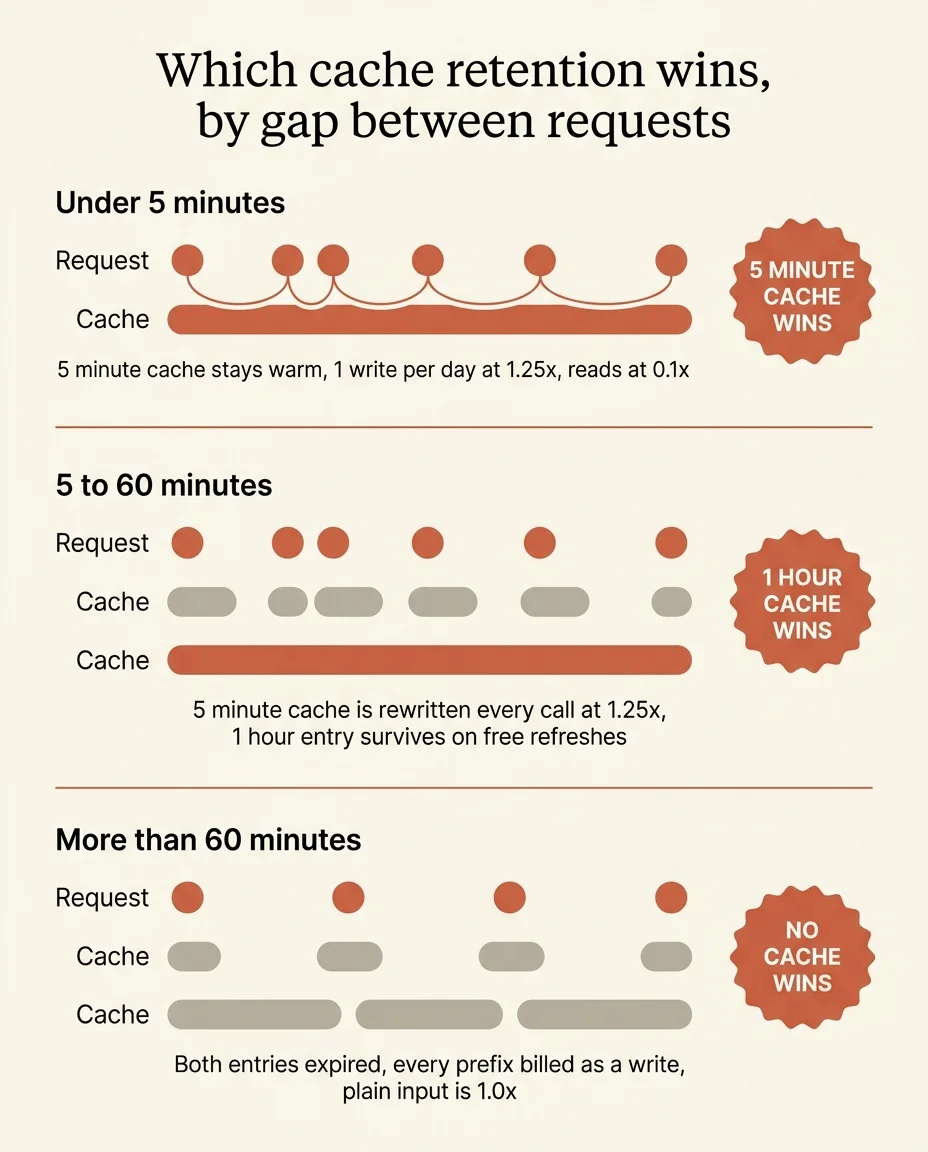
Reading a cached prefix resets its clock at no cost. That single rule turns retention into a step function with three regimes, and your average delay between two calls tells you which one you are in.
- Under five minutes of silence, the short cache never expires. One write covers the whole day and the cheaper 1.25x write wins.
- Between five and sixty minutes, the short cache is dead on arrival every single time while the one hour entry survives on free refreshes. The long retention wins by a wide margin.
- Past an hour, both entries have expired before the next call lands. Every request pays a write, and plain uncached input at 1.0x is cheaper than either.
The middle band is the one that costs teams money without anyone noticing. A five minute cache that misses is not merely useless, it bills the prefix at 1.25 times the standard input rate, so a workload with ten minute gaps pays 25 percent more for that prefix than if caching had never been switched on.
Between five and sixty minutes of silence, writing a five minute cache costs 25 percent more than sending the same prefix uncached.
A worked example on Claude Sonnet 5
Take an internal assistant on Sonnet 5 with a 30,000 token prefix, a system prompt plus a product knowledge block that never changes. It handles 60 requests a day, roughly one every ten minutes, each adding 600 fresh input tokens and returning 500 output tokens.
Output and fresh input are identical across the three strategies, $0.372 a day. Only the prefix moves, and it moves a lot.
| Strategy | Writes per day | Cost per month |
|---|---|---|
| No caching | 0 | $119.16 |
| Five minute cache | 60 | $146.16 |
| One hour cache | 1 | $25.38 |
The long retention costs a fifth of the short one on the same traffic, and the short one is the most expensive of the three. Changing the time to live in the request body is worth $120.78 a month here, and the same ratio holds if you scale the prefix or move it to Opus 5.
The premium for the long retention is 0.75 times the input price, once. Every re-write it avoids is worth 1.15 times that price, so the one hour column is ahead from the first request that lands outside the five minute window.
What breaks a cache before the clock does
Time is not the only thing that invalidates an entry. As the prompt caching documentation sets out, Claude caches in a strict hierarchy, tools then system then messages, and a change at one level invalidates that level and everything after it.
Changing a tool definition wipes the whole prefix. Toggling web search or citations keeps the tools cached but drops system and messages. Changing tool choice or adding an image drops the message cache only.
A prompt builder that reorders tool definitions between deploys is quietly paying full write price on every call. One recent change removes a long standing workaround: on Fable 5, Mythos 5, Opus 5 and Opus 4.8, a new instruction can be appended as a system role message inside the conversation rather than edited into the top level system field, which leaves the cached prefix untouched.
Sonnet 5 is not on that list. On the model used in the worked example above, an operator instruction still has to go into the top level system field, and it still invalidates the whole prefix behind it.
a number of useful tips + tricks for Opus 4.8: 1/ you can now update the system prompt mid-conversation w/o breaking the prompt cache. previously, you had to add system-reminder tags to user messages.
Lance Martin (@RLanceMartin), post of 28 May 2026 on X
When no cache at all is the cheapest line
Caching only pays when something repeats. Two common workloads have nothing to reuse, and on both of them every cache flag is pure surcharge.
The first is slow traffic. A reporting job that fires twenty times a day, three hours apart, finds an expired entry on every call: 1.25x on the short cache, 2x on the long one, against 1.0x for sending the prompt plainly. The calculator above flips its verdict to no caching as soon as the gap passes sixty minutes.
The second is the one shot generation, where a single large prompt produces a single large answer and the session ends. The bill there is almost entirely output, and no retention setting touches output.
Claude Opus 5 one-shotted this game. EVERYTHING you see in this demo is custom code… not a single external asset was used. AI games are going to be amazing.
Matt Shumer (@mattshumer_), post of 25 July 2026 on X
A run like that spends its budget at $25 per million output tokens on Opus 5. Caching the prompt would shave cents off an input side that was never the problem.
What the per million rate leaves out
Two grids can look identical and bill differently, because the price per million is only half of the equation. The other half is how many tokens your text turns into, and which multipliers stack on top. Every rate in this section was read from the official pricing page on the same day as the grid above, 14 August 2026.
Claude 4.7 and later count about 30 percent more tokens
Anthropic switched tokenizer with Claude 4.7. Every model from that generation on, Opus 5, Sonnet 5 and Fable 5 included, produces roughly 30 percent more tokens for the same text than Sonnet 4.6 and earlier, with the exact figure depending on the content.
That reframes the Sonnet comparison. Sonnet 5 at $2 against Sonnet 4.6 at $3 reads as a cut of a third, but 30 percent more tokens for the same document eats most of it, and the real saving lands nearer 13 percent. Count the tokens before you assume a migration saves money, and apply the same test when you line Claude up against another provider’s per million rates.
Batch, fast mode and US-only inference
Three modifiers move every column at once, and they stack with the cache multipliers rather than replacing them.
The Batch API takes 50 percent off input and output, which puts Sonnet 5 at $1 and $5 and Opus 5 at $2.50 and $12.50. Fast mode goes the other way, pricing Opus 5 and Opus 4.8 at $10 input and $50 output, first party API only, and it cannot be combined with batch. Pinning inference to the United States through the geography parameter applies a 1.1x multiplier to everything, cache writes and cache reads included.
Tools and agent sessions billed on top of tokens
Server side tools are metered separately from tokens. Web search is $10 per 1,000 searches plus the tokens the results consume, while web fetch adds nothing beyond the tokens of the page you pulled in. Code execution is free alongside either of them, and otherwise gives every organization 1,550 free hours a month before charging $0.05 per hour, per container.
Claude Managed Agents add a runtime line of $0.08 per session-hour, counted only while a session is actually running. If you are weighing Claude against other providers, our comparison of every major LLM API puts the same workload through fourteen models side by side.
Frequently asked questions
Does reading a cache reset the clock?
Yes, and at no extra charge. Anthropic’s own grid names that column Cache Hits and Refreshes, which is why a busy prefix survives all day on a single write. Every read restarts the retention clock, so an entry only dies after a gap longer than the window with no traffic at all.
Is Claude Sonnet 5 still going up to $3 in September?
No. The $2 and $10 pair was launched as introductory pricing through 31 August 2026, and as of the page we read on 14 August 2026 the documentation states that it is the standard price and that the increase scheduled for 1 September 2026 will not occur.
Can batch and caching be combined?
Yes. The batch discount and the cache multipliers stack, so a cached read inside a batch job is billed at 0.1 times the already halved input rate. Fast mode is the exception: it is not available through the Batch API.
How small can a cached prefix be?
The floor depends on the model: 512 tokens on Opus 5 and Fable 5, 1,024 on Sonnet 5 and Opus 4.8, 2,048 on Opus 4.7, and 4,096 on Haiku 4.5 and Opus 4.6. Below that, nothing is cached and no error is returned. Check the cache creation and cache read fields in the usage block to confirm a prefix is being stored at all.
How often is this grid re-checked?
Monthly, and immediately after any Anthropic pricing announcement. We archive a screenshot of the official page each time, so a figure here can always be traced back to what the provider was publishing that day, following the way we test and verify.