
OpenRouter takes no margin on tokens: on 14 August 2026 the prices it listed for Claude Sonnet 5, grok-4.6 and Mistral Large matched the provider grids to the cent, and its revenue arrives instead through a 5.5 percent fee on prepaid credits. The alternatives split into two billing models, a percentage of model spend at Requesty and a flat subscription at Portkey and Helicone, with the open source LiteLLM proxy charging neither. Below roughly 890 dollars of monthly tokens the percentage is the cheaper layer, above it the subscription wins. The comparator below ranks the six on your own volume.
What each router costs you on the same tokens
Enter what your tokens cost at provider list price and how many requests that represents. Every fee below was read from the router's own pricing page on 14 August 2026.
What each router adds to your bill
Every figure on this page comes from two readings taken on the same day, 14 August 2026: the router’s own pricing page, and the provider grid we publish in our model by model price comparison. The margin is the difference between the two, not what the router says about itself.
| Router | What it adds on top of provider list price |
|---|---|
| OpenRouter | Nothing on tokens, 5.5 percent on prepaid credits, nothing with your own keys under 25,000 dollars a month |
| Requesty | 5 percent of the base model cost, applied after the catalog price |
| LiteLLM | Nothing on the open source proxy, enterprise pricing not published |
| Portkey | 0 to 49 dollars a month by log volume, then 9 dollars per extra 100,000 |
| Helicone | 0 to 79 dollars a month by request volume, plus usage charges it does not quantify |
| Direct to the provider | Nothing, and no routing layer either |

OpenRouter: nothing on tokens, 5.5 percent on the way in
We pulled the full OpenRouter catalog on 14 August 2026, 411 models, and compared it line by line with the provider grids read the same day. On the models both sides publish, the numbers are identical: gpt-5.6-sol at 5.00 dollars in and 30.00 out, Claude Fable 5 at 10.00 and 50.00, Claude Opus 5 at 5.00 and 25.00, Claude Sonnet 5 at 2.00 and 10.00, grok-4.6 at 2.00 and 6.00, DeepSeek V4-Flash at 0.14 and 0.28, Mistral Large at 0.50 and 1.50.
The money leaves elsewhere. OpenRouter’s own documentation on fees puts 5.5 percent on credit purchases by card, with an 80 cent minimum, and 5 percent by cryptocurrency. If you bring your own provider keys, the first 25,000 dollars of monthly usage carries no fee at all, and 5 percent applies above that.
OpenRouter listed Claude Sonnet 5 at 2.00 dollars in and 10.00 out on 14 August 2026, the same figures Anthropic published that day. The margin is not in the token price, it is in the top-up.
The fee is therefore a function of how you fund the account, not of how much you use it.
Requesty: five percent, applied after the catalog price
Requesty publishes its model list openly, 661 entries on 14 August 2026, and those entries carry the provider price with no adjustment: claude-sonnet-5 at 2.00 and 10.00, gpt-5.6-sol at 5.00 and 30.00, deepseek-v4-flash at 0.14 and 0.28. Reading the catalog alone, you would conclude there is no margin.
The Requesty pricing page is explicit about the rest: a 5 percent markup on base model costs, with its own worked example of a 10 dollar model billing at 10.50. The margin exists, it is simply applied at invoice time rather than shown in the catalog. The free plan runs 200 requests a day on free models with no card.
LiteLLM, Portkey and Helicone: a subscription instead of a cut
These three never touch the token price, and the reason is structural rather than generous: you plug your own provider keys into them, so the provider bills you directly and the gateway only sees the traffic. Their revenue comes from what they charge for the layer.
What they charge for that layer, read on 14 August 2026:
- LiteLLM: nothing for the open source proxy, which ships fallbacks, load balancing and per-key budgets. Enterprise pricing is not published, only a 30 day trial key.
- Portkey: free to 10,000 logs a month, then 49 dollars for 100,000, then 9 dollars per additional 100,000. Its gateway is open source too if you would rather host it.
- Helicone: free to 10,000 requests, then 79 dollars a month on Pro and 799 on Team, with usage based charges on top.
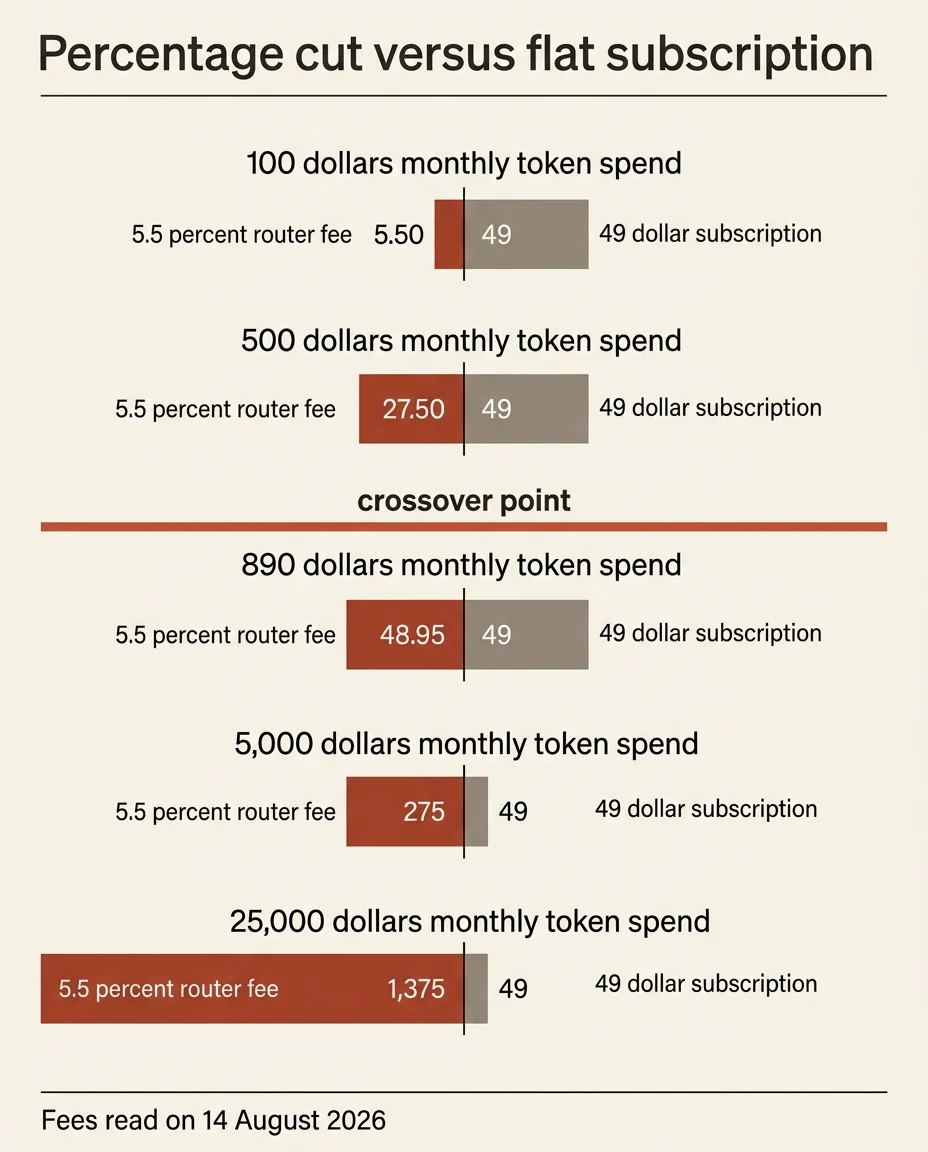
The arithmetic that matters is where a flat fee beats a percentage. Portkey’s 49 dollars equals 5.5 percent of about 890 dollars of monthly tokens, and Helicone’s 79 dollars equals it at about 1,440 dollars. Under those thresholds the percentage routers cost less; over them, the subscription stops scaling with your bill while the percentage never does.
The gap that costs the most is the default route
Focusing on fees misses the number that actually moves an invoice. A router that takes zero margin can still cost you two or three times the provider price, because it picks which host serves your request and the hosts do not charge the same.
The same DeepSeek model at two very different prices
On 14 August 2026, the default OpenRouter listing for deepseek-v4-pro was 1.168 dollars in and 2.336 out. DeepSeek’s own endpoint, visible on the same page as one of the 18 providers serving that model, was 0.435 and 0.87. The spread across the full list ran from 0.4138 at StreamLake to 1.91 at Azure, a factor of more than four for identical weights.
Eighteen hosts served DeepSeek V4-Pro through OpenRouter on 14 August 2026, from 0.4138 to 1.91 dollars per million input tokens. The default route was the seventh cheapest, not the first.
This is not a fee and it is not hidden, it is a default. Pin the provider you want, or set a price ceiling on the route, and the number returns to something close to list. Leave the default in place and you are paying a routing preference you never chose, which dwarfs any 5 percent argument.
When the router lands under the provider
The same mechanism runs the other way. GLM 5.2 was listed at 1.19 in and 3.74 out through OpenRouter on 14 August 2026, against 1.40 and 4.40 on the provider grid we read that day, roughly 15 percent under list. DeepSeek V4-Pro had endpoints at 0.4138 and 0.4225, both below DeepSeek’s own 0.435.
So the honest summary is not that routers are more expensive or cheaper than going direct. They are a marketplace, and on a marketplace the price depends on who is serving you at that moment.
What we could not measure
Several numbers here are missing because the vendors do not publish them, and we would rather say so than estimate. Helicone’s usage based rate beyond the free allocation is not quantified, so every Helicone figure in the comparator is a floor. LiteLLM enterprise and Portkey enterprise are both quoted on request.
Requesty allows your own keys on pay as you go without saying whether the 5 percent still applies to that traffic, so we kept it in the calculation.
OpenAI’s flagship, gpt-5.6-cyber, was not in the OpenRouter catalog at all on the day we checked, which is a real limit for frontier work. We also left cached input out of the measurement, because OpenRouter’s cache figures for DeepSeek V4-Flash and grok-4.6 did not reconcile with the provider grids read the same day. Our full method is in how we test.
Which router fits which profile
There is no best router here, only a best fit for a spend level and an operating constraint. Some links on this page are affiliate links, and our affiliate disclosure covers what that changes: nothing in the order below, which comes out of published prices.
Solo developer, small and irregular volume
Under a hundred dollars a month the fee argument is noise and the free tiers decide it. OpenRouter costs at most 5.50 dollars a month in card fees at that volume and puts 411 models behind one key, which is the fastest way to try something new. Requesty’s 200 free requests a day cover prototyping without a card at all.
A team that has to explain its spend
Once several people share a key, the question stops being the margin and becomes who spent what. Portkey and Helicone are built for that, with per-key budgets, logs and alerts. Past the crossover points above, 890 dollars of monthly tokens for Portkey and 1,440 for Helicone, their flat fee also costs less than a percentage cut.
Self-hosted, air-gapped or regulated
If the traffic cannot leave your infrastructure, the field narrows to two. LiteLLM runs entirely on your side as an open source proxy, and Portkey publishes an open source gateway with routing and fallbacks intact. Helicone offers on premises deployment only at enterprise level, and OpenRouter and Requesty are managed services with no self-hosted option.
Staying with one provider
Going direct stays a legitimate answer, which is why the comparator includes it. One model family, no fallback requirement and observability you already have, and a gateway mostly adds a dependency. The moment you need a second provider or a per-team budget, you are rebuilding a router by hand.
Switching without rewriting the application
The OpenAI compatible endpoint everyone speaks
All five routers expose an OpenAI compatible chat completions endpoint, so migration is usually a base URL, an API key and a model string rather than a rewrite. The model string is the part that bites: identifiers are namespaced differently on each router, and a name that resolves on one will 404 on another. Log the model actually served, not the one you requested, because on a marketplace router the two can differ.
What actually breaks when a fallback fires
Fallbacks are the reason most teams adopt a router, and they are also the least tested path in the stack. When traffic moves to another host, three things change quietly:
- the tokenizer, so the context budget you sized for no longer holds;
- the tool calling format, so structured output can come back malformed;
- the price, so a cheap route becomes an expensive one without an alert.
Set a ceiling on the fallback price where the router supports it, and assert on the shape of your structured output rather than trusting it. A fallback that returns a wrong answer costs more than an outage you noticed.
Frequently asked questions
Is OpenRouter more expensive than going direct?
On tokens, no: on 14 August 2026 its listed prices matched the provider grids on every model both sides published. You pay 5.5 percent on card top-ups, or nothing with your own keys under 25,000 dollars a month. It becomes expensive only when the default route sends a request to a costlier host.
Which alternative is genuinely free?
LiteLLM, if you self-host it: no license cost, no token markup, and you pay only for the container. Portkey and Helicone are free to 10,000 logs and 10,000 requests a month, which covers a side project comfortably and a production service for about a day.
Does a gateway add latency?
It adds a network hop whose size depends on where the gateway sits relative to you and to the provider, and a self-hosted instance in your own region adds the least. We have not benchmarked the five against each other, so measure it on your own traffic rather than taking a number from anyone.
Can you keep your own provider keys?
Yes on all five, and it changes the economics more than any other single choice. The provider then bills you at list price, the router bills you for the layer, and the percentage argument disappears on OpenRouter under its allowance.