
Gemini bills by the token, and on 14 August 2026 the paid text rates run from $0.10 per million input tokens on Gemini 2.5 Flash-Lite to $4.00 per million on Gemini 3.1 Pro Preview once a prompt crosses 200,000 tokens. Output is always the expensive half, billed at four to more than eight times the input rate depending on which row you land on. What Google’s pricing page gives you is a rate card, not a bill: it never tells you what one request costs or what a month of them adds up to. The calculator below and the three worked examples after it do that conversion, and every figure in this article was read off the official grid on 14 August 2026.
Gemini token cost calculator
Pick a model, describe one typical request, get the monthly bill. Rates read from Google's official pricing page on 14 August 2026, text modality, paid tier.
0.00
per month
| Same workload, every model | Input, per 1M | Output, per 1M | Per 1,000 requests | Per month |
|---|
Long-context rates apply automatically on Gemini 3.1 Pro Preview and Gemini 2.5 Pro when input passes 200,000 tokens per request. Thinking tokens are added to output before billing. Cache storage rent is not included here because it depends on how long you keep the cache alive, not on request volume.
The cost of one Gemini call, in one line
Every Gemini invoice comes from the same arithmetic. Take the tokens you sent that were not already in a cache, multiply by the input rate. Take the tokens you sent that were served from a context cache, multiply by the cached rate. Take the tokens the model produced, including the thinking tokens you never see, multiply by the output rate. Divide the whole thing by a million, because Google quotes everything per million tokens, and nobody sends a million tokens in a single call.
That fourth term is where most estimates go wrong: a request with a 1,200 token prompt and a 250 token answer looks cheap until a thinking budget adds 2,000 invisible tokens to the output side. For the same arithmetic applied across vendors rather than inside one, our pillar on how Gemini sits against every other provider runs this formula on OpenAI, Anthropic, DeepSeek, xAI and Mistral.
The Gemini price grid, read line by line
Google’s page is hard to read because four things vary at once: the model, the service tier, the modality of the input and, on the Pro rows only, the length of the prompt. Fix the modality at text and the tier at Standard, and the grid collapses into three families that behave very differently.
The Pro tier and its 200k cliff
Gemini 3.1 Pro Preview is billed at $2.00 per million input tokens and $12.00 per million output tokens for prompts of 200,000 tokens or fewer. Past that line the same model charges $4.00 and $18.00. Cached input follows the same split, $0.20 then $0.40, and cache storage costs $4.50 per million tokens per hour. Gemini 2.5 Pro works the same way at lower numbers: $1.25 and $10.00 under the threshold, $2.50 and $15.00 above it, cached input at $0.125 then $0.25.
The threshold is evaluated per request on the size of the prompt, not on your monthly volume and not on the model’s context window. A pipeline that averages 190,000 tokens per call and occasionally spikes to 210,000 is paying two different prices for what looks like one workload.
The Flash tier, and the promotional rate with an expiry date
Gemini 3.7 Flash and Gemini 3.6 Flash both sit at $0.75 input and $3.75 output, with cached input at $0.075 and storage at $0.50 per million tokens per hour. Those are promotional numbers. The grid states plainly that they hold through 31 December 2026 and that from 1 January 2027 they become $1.50, $7.50, $0.15 and $1.00. Anyone budgeting a 2027 fiscal year off today’s Flash rate is budgeting half of what they will pay.
The rest of the family: Gemini 3.5 Flash at $1.50 and $9.00, Gemini 3 Flash Preview at $0.50 text input and $3.00 output, Gemini 2.5 Flash at $0.30 and $2.50. No Flash row carries a long-context threshold, which is why a Flash model pulls further ahead of a Pro model on long prompts than the headline rates suggest.
The Flash-Lite tier, where high volume belongs
Gemini 2.5 Flash-Lite is the cheapest text row on the whole page, at $0.10 input and $0.40 output, with cached input at one cent per million. Gemini 3.1 Flash-Lite asks $0.25 and $1.50. Gemini 3.5 Flash-Lite asks $0.30 and $2.50, which is the same input rate as Gemini 2.5 Flash and more than six times the output rate of Gemini 2.5 Flash-Lite.
Lite is a shape, not a price. Newer Lite models are not cheaper than older ones, and on output the newest Lite row costs six times the oldest. Choosing by version number rather than by rate is how a routine upgrade multiplies a classification bill.
Four multipliers the grid makes you work out yourself
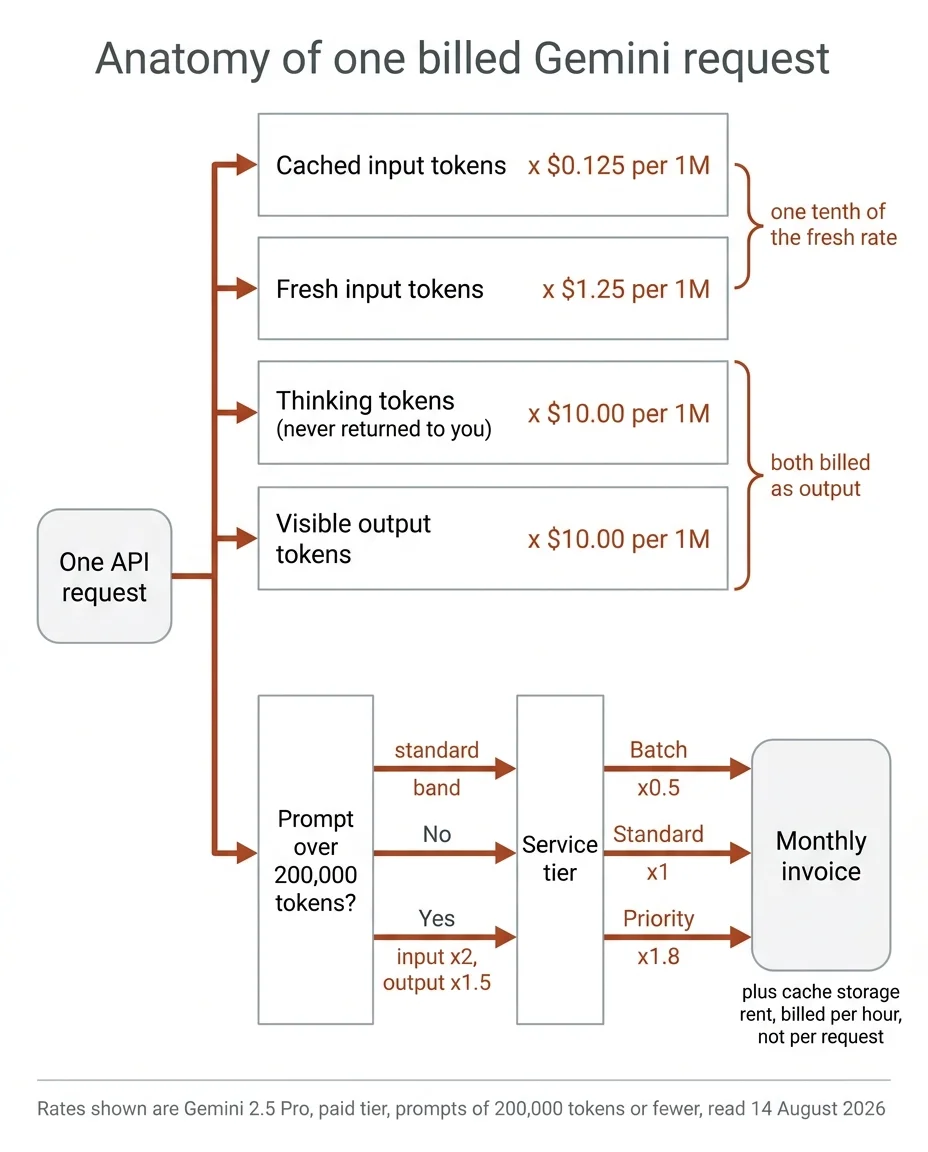
Four mechanisms sit between those rates and the invoice, and each moves the total by more than a change of model usually does.
Output is billed four to eight times higher than input
The ratio between the output rate and the input rate is the single most useful number to carry in your head. On Gemini 2.5 Flash-Lite it is four. On Gemini 3.7 Flash it is five. On Gemini 3.1 Pro Preview and Gemini 3.1 Flash-Lite it is six. On Gemini 2.5 Pro it is eight, and on Gemini 2.5 Flash and Gemini 3.5 Flash-Lite it is 8.3.
Trimming a system prompt saves you input tokens at the cheap rate. Capping the length of the answer saves output tokens at a rate up to 8.3 times higher.
Thinking tokens are billed at the output rate
Reasoning output is billed exactly like visible output. It has no line of its own on the grid and never reaches the response your code parses, so it is invisible everywhere except the invoice. A thinking budget of 2,000 tokens on Gemini 3.1 Pro Preview costs $0.024 per call before the model writes a word of its answer. At 100,000 calls a month that is $2,400 of tokens nobody reads.
Caching has two prices, and the second one is rent
On every text row of the grid, cached input is priced at exactly one tenth of fresh input. That is a 90% discount on the repeated part of your prompt, which is why context caching looks like free money. The second price is what makes it conditional: storage is billed by the hour, at $1.00 per million tokens per hour on the Flash rows, $4.50 on the Pro rows and $0.50 on the two promotional rows, Gemini 3.7 Flash and Gemini 3.6 Flash.
Put numbers on it. Keeping a 200,000 token context cached on Gemini 2.5 Pro costs $0.90 an hour, which is $657 over a 730 hour month. Each cache hit saves $0.225 of input. Break-even is 2,920 hits a month, or four an hour, every hour, all month. Below that rhythm the cache costs more than it saves, and a cache left alive over a quiet weekend is pure loss.
Batch halves the bill, Priority nearly doubles it
Google publishes four service tiers on most rows. Batch is exactly half the Standard rate on fresh input and on output, on every model we checked, and Flex matches Batch almost everywhere. Priority is uniformly 1.8 times Standard, on input, on output, on cached input and on cache storage.
Cached input is where that pattern breaks. On Batch it halves for Gemini 3.7 Flash, Gemini 3.6 Flash, Gemini 3.5 Flash and Gemini 3.1 Flash-Lite, falls only from $0.03 to $0.02 per million on Gemini 3.5 Flash-Lite, and does not move at all on Gemini 3.1 Pro Preview, Gemini 2.5 Pro, Gemini 3 Flash Preview, Gemini 2.5 Flash and Gemini 2.5 Flash-Lite. Flex adds one rounding difference of its own, asking $0.08 on the cached input of Gemini 3.5 Flash against $0.075 on Batch.
End to end, the tier decision is still worth 3.6x, though a job that leans hard on a context cache keeps a little less of that. Any work that tolerates a delayed response, which covers most classification, extraction, enrichment and evaluation jobs, belongs on Batch, and moving it there saves more than most model downgrades.
Three workloads, priced end to end
The calculator presets load these three scenarios directly, so you can change one field at a time and watch which one moves the total.
A support assistant at 300,000 requests a month
Assume 1,200 input tokens per turn with 60% of that served from a cached system prompt, and 250 tokens of answer, on the Standard tier. On Gemini 2.5 Flash-Lite that workload costs $46.56 a month. On Gemini 3.5 Flash-Lite it costs $237.18. On Gemini 3.7 Flash it costs $405.45, and that is at the promotional rate that expires at the end of 2026.
Same traffic, same prompt, an 8.7x spread. Output is doing the work: at 250 tokens of answer against 480 tokens of fresh input, it is already the majority of the bill on every row, the cheapest included, where it accounts for 64% of the total.
A document pipeline that crosses the 200k line
Assume 4,000 documents a month at 320,000 input tokens each, no caching, 1,500 tokens of answer and a 2,000 token thinking budget, on Gemini 3.1 Pro Preview. Because the prompt is over the threshold, input bills at $4.00 and output at $18.00, and the month costs $5,372.00.
Trim the same job to 180,000 tokens through better retrieval and input drops to the $2.00 band, output to $12.00, and the month to $1,608.00. A 44% cut in prompt length produced a 70% cut in the bill, because the tokens got cheaper at the same time as they got fewer. It is the one place in the grid where an engineering decision has a discontinuous price effect.
An overnight classification batch
Assume two million short calls a month, 800 input tokens and 40 output tokens each, on Gemini 2.5 Flash-Lite. On the Batch tier that is $96.00 a month, on Standard $192.00, and on Priority $345.60. Nothing about the work changed, only the queue it waits in.
At this volume the queue moves the bill further than the model row does, which is the point where it pays to check what a rival charges for the same shape of call. Our comparison of every major model per million tokens holds the other vendors’ rates, read on the same day.
The free tier, and what it costs instead of money
Almost every Gemini text model carries a free tier marked as free of charge, Gemini 2.5 Pro included. The notable exception is Gemini 3.1 Pro Preview, which is paid only. The allowance is capped by request rate rather than token volume, so it is a prototyping tier, not a production one.
The grid also carries a line stating whether prompts are used to improve Google’s products. On the rows that offer a free tier it reads yes; on Gemini 3.1 Pro Preview, which has none, it reads no. Together those two lines say the free tier is priced in data rather than dollars, a reasonable trade for a prototype and a poor one for customer conversations.
How we checked these prices
Every rate quoted here was read off the official Gemini API pricing page at ai.google.dev on 14 August 2026, paid tier, text input unless stated otherwise. We transcribed the Standard, Batch, Flex and Priority columns for ten text models and reread the page a second time to catch transcription errors. Every monthly total above was computed with the formula the calculator uses, so you can reproduce any of them by loading the matching preset.
What we did not check: Vertex AI, which prices the same models on a separate grid with its own commitments and regional rates, and the image, video, music, embedding and robotics rows, billed per image, per second or per frame rather than per token. Google changes this page without notice, so treat 14 August 2026 as the shelf life of these numbers. That dating discipline is written up in the protocol behind every comparison here.
Frequently asked questions
What does one million Gemini tokens cost?
It depends on whether they went in or came out. One million input tokens cost from $0.10 on Gemini 2.5 Flash-Lite to $4.00 on Gemini 3.1 Pro Preview past the 200k threshold; one million output tokens cost from $0.40 to $18.00 on the same two rows. A single figure quoted without a direction is meaningless.
Is the Gemini API free?
There is a free tier on most models, Gemini 2.5 Pro included, but not on Gemini 3.1 Pro Preview. It is capped by request rate rather than token volume, and the grid indicates free tier prompts are used to improve Google’s products.
Do thinking tokens cost extra?
They are not extra, they are output. Gemini bills reasoning tokens at the visible answer rate, so a 2,000 token thinking budget on Gemini 3.1 Pro Preview adds $0.024 to every call. Setting that budget is a pricing decision as much as a quality one.
Why did the bill jump when prompts got longer?
Almost certainly the 200,000 token threshold on a Pro model. Gemini 3.1 Pro Preview and Gemini 2.5 Pro double their input rate and raise output by half once a single prompt passes that mark. The test runs per request, so a small rise in average prompt length can push a large share of traffic across the line at once.