
DeepSeek is free to use and not free to build on. The app, the web chat and the mobile clients cost nothing, and as of 14 August 2026 DeepSeek publishes no consumer subscription at all: there is no Plus, Pro or Premium tier to buy. The line sits at the API key. From the first token you send through it, you are billed at $0.14 per million input tokens and $0.28 per million output tokens on deepseek-v4-flash, and every figure on this page carries the date we read it from DeepSeek’s own pricing page.
What DeepSeek actually costs you per month
The app and the web chat are free, so the only question worth pricing is the API. Enter the volume you expect to send. Every rate below was read from the provider's own pricing page on 14 August 2026, per million tokens, standard tier.
The free app is not in the table because it never bills you: it is capacity limited, not credit limited. Reference models are there to show the scale of the gap, not to be recommended. The off-peak checkbox applies a flat 50 percent to the DeepSeek rows only, which is the order of magnitude DeepSeek announces for its discounted window. We did not independently verify the exact hours, so treat that line as an estimate and check the window on the pricing page before you design around it.
Where the free line sits
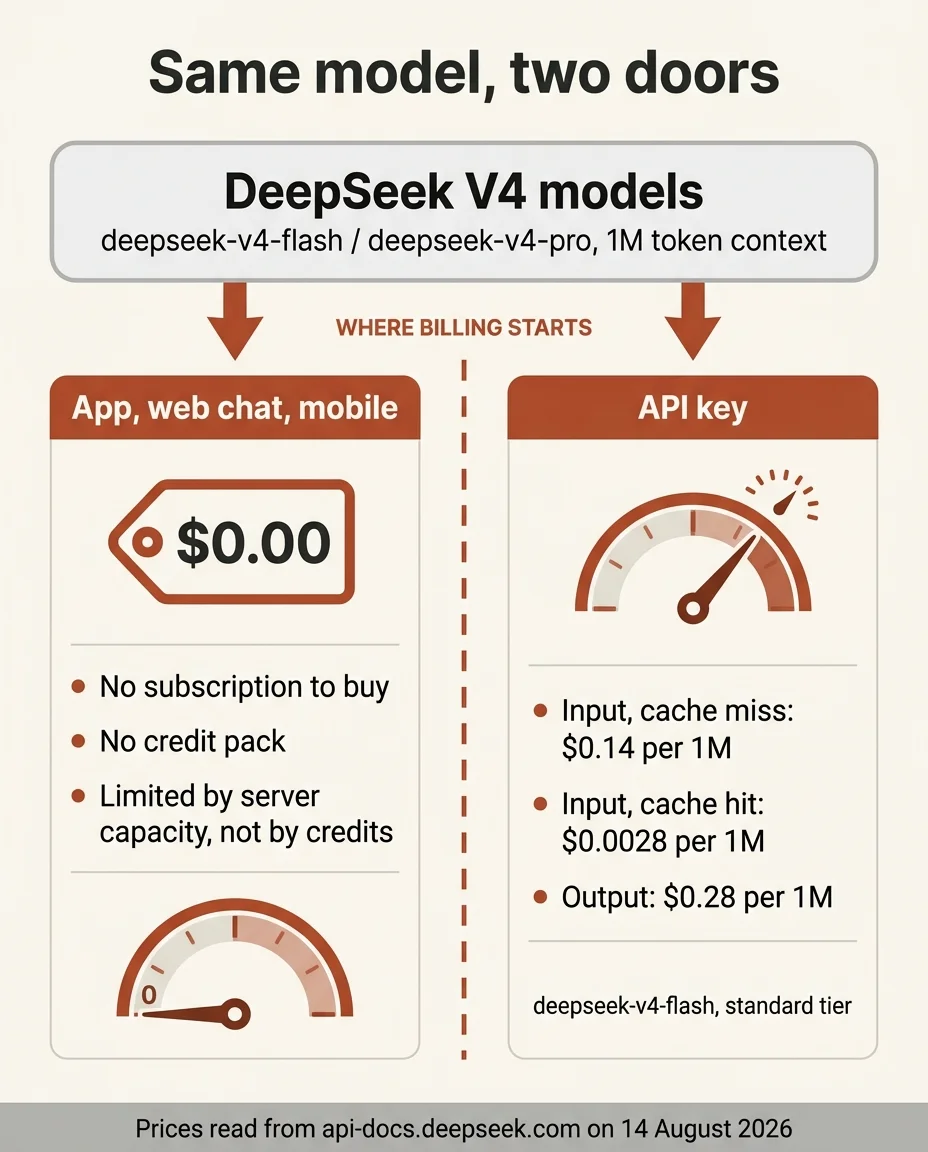
Almost every question about DeepSeek pricing comes down to one distinction that the marketing never spells out. There is a consumer product, which is free, and a developer product, which is metered. They share a name and a model family, but they are billed on completely different logic, and confusing the two is how people end up either paying for nothing or getting an invoice they did not expect.
The app and the web chat cost nothing
You can open chat.deepseek.com, or install the iOS or Android client, and start a conversation without a payment method. There is no credit pack, no message quota you can top up with money, and no premium tier that unlocks a better model. We checked the DeepSeek site and its pricing documentation on 14 August 2026 and found published prices for the API only. That is genuinely unusual: OpenAI, Anthropic and Google all monetize their consumer clients with a monthly subscription, and DeepSeek so far does not.
The API bills from the first token
The moment you create a key on the developer platform, you are on a prepaid balance that is drawn down per token. Two models sit on the price list, deepseek-v4-flash and deepseek-v4-pro, both with a one-million-token context window. The published grid contains no free allowance and no perpetual free tier. If a promotional credit exists for new accounts, it was not part of the pricing page we read on 14 August 2026, so do not plan around it.
The DeepSeek API price grid, read on 14 August 2026
All figures below are per million tokens, standard tier, taken from api-docs.deepseek.com on 14 August 2026. We archive a screenshot of the grid on the day we read it, so any number here can be traced back to what DeepSeek was publishing that day.

| Model | Input, cache miss | Input, cache hit | Output |
|---|---|---|---|
| deepseek-v4-flash | $0.14 | $0.0028 | $0.28 |
| deepseek-v4-pro | $0.435 | $0.003625 | $0.87 |
V4-Flash and V4-Pro, side by side
The two models are priced on an exact multiple. V4-Pro costs 3.1 times V4-Flash on input, and 3.1 times on output, the same ratio to three decimal places. Inside each model, output costs exactly twice input.
That two-to-one ratio is the detail worth noticing. Across the wider per-million-token grid, output runs at three to six times input, and OpenAI prices its entire line at exactly six. A verbose application that gets punished at those ratios is barely penalized here.
The practical reading is that switching from Flash to Pro triples your bill whatever your workload looks like, with no crossover point to hunt for. You are not choosing between a model that suits long inputs and one that suits long outputs. You are choosing whether the answer quality is worth three times the money.
The cache hit, the cheapest number on the page
Cached input is where DeepSeek separates itself from everyone else. When you resend content the API has already seen, typically a system prompt or a document you keep in context, V4-Flash bills it at $0.0028 instead of $0.14, a fiftyfold discount. V4-Pro goes further: $0.003625 against $0.435 is exactly one hundred and twenty times cheaper.
Most production workloads repeat themselves far more than their designers assume. Set the cache share to eighty percent in the estimator above and watch the input column collapse while the output column stays exactly where it was, because caching never touches the generation side of the bill. If your bill is dominated by input, you have a caching problem rather than a pricing problem.
Off-peak billing, and what we did not verify
DeepSeek publishes a discounted window on top of the standard grid, at roughly half the normal rate, which is rare enough to be worth designing around if your work can wait. We verified the standard rates directly against the pricing documentation on 14 August 2026. We did not independently verify the exact hours of the discounted window, and the documentation describes a peak and off-peak split that was still moving in August 2026. Treat the off-peak checkbox in the estimator as an order of magnitude, and read the window off the pricing page before you build a scheduler around it.
What a real month costs, in dollars
Rates per million tokens are hard to feel. Two concrete profiles, both priced on the 14 August 2026 grid, make the number tangible.
A side project answering a few thousand questions
Three thousand calls a month, roughly 1,500 tokens of input and 400 tokens of output each. That is 4.5 million input tokens and 1.2 million output tokens.
On V4-Flash with no caching at all, the month costs $0.97. Add an eighty percent cache hit rate and it drops to $0.47. On V4-Pro the same month costs $3.00 without caching. At this scale the honest answer is that the API is free in every sense that matters: you will spend more on the domain name.
A production workload with a repeated system prompt
Five hundred thousand calls a month, a 2,000-token system prompt on every call, 300 tokens of user input and 250 tokens of answer. That is 1,150 million input tokens and 125 million output tokens, with 87 percent of the input eligible for a cache hit. On V4-Flash the month lands at about $59. Without caching, the same traffic costs $196, so the cache is doing more than two thirds of the work.
For scale, the identical workload on Claude Sonnet 5, at $2.00 input, $0.20 cached and $10.00 output on 14 August 2026, comes to roughly $1,749. That is thirty times the DeepSeek bill for the same tokens, which is the real reason people ask whether DeepSeek is free: at these prices it rounds to free next to the frontier tier. We take that grid apart, cache lines included, in our read of Claude API pricing.
What the free app costs you instead of money
Free consumer products are paid for somehow, and it is worth being precise about how, rather than vague and ominous about it.
Consumer terms are not API terms
The app and the web chat are governed by a consumer privacy policy, not by the developer terms that cover the API. Those two documents differ at every provider, usually on whether your inputs can be used to improve the models. We did not audit DeepSeek’s data handling for this page, and we are not going to assert something we have not read line by line. Read the privacy policy yourself before pasting client work, source code or anything confidential into a free chat window, whichever provider it belongs to.
Capacity is the limit, not credits
What throttles the free clients is server capacity rather than a balance. When demand spikes, the app slows down or refuses new messages, and there is nothing you can buy to jump the queue because no paid tier exists. The API is the paid queue. If availability matters to your workflow, that is the actual argument for moving off the free app, more than any feature difference.
Running DeepSeek without paying DeepSeek
There is a third lane that most pricing pages ignore, and for DeepSeek specifically it is a real option rather than a theoretical one.
The weights run on your own hardware
DeepSeek ships model weights, so the marginal cost of a token can be your own electricity instead of an invoice. Quantized local builds of V4-Flash appeared within days of the API release, with the setup published alongside them.
Post on X
The Unsloth team published local builds of DeepSeek-V4-Flash-0731, together with the configuration needed to run the model on your own machine.
We have not benchmarked a local deployment for this page, and the hardware bill is real: a large mixture-of-experts model wants a lot of memory before it wants a fast GPU. But for teams with a compliance reason to keep data in house, running the weights removes the metering question entirely.
Third-party hosts resell the same model
Inference platforms pick up DeepSeek releases quickly, and V4-Flash appeared on third-party APIs in August 2026. Their pricing is their own, their rate limits are their own, and their cache behavior is frequently not the same as DeepSeek’s. If you go that route, price the endpoint you are actually calling rather than the grid above: router pricing works differently, and the cache hit rate is where the two diverge most.
Is the cheap tier good enough for what you need?
Price only settles the question if the quality clears your bar, and this is where the answer stopped being obvious in 2026. DeepSeek’s V4 releases put the cheap tier into benchmark territory that used to belong to models costing thirty times more, particularly on agentic and coding tasks.
Post on X
Petri Kuittinen posted the DeepSeek V4-Pro 0813 benchmark results, comparing them run by run against the frontier models on coding and agentic suites.
We have not reproduced those numbers ourselves, and vendor-adjacent benchmark posts deserve the same skepticism as vendor benchmarks. What they do establish is that the gap is no longer wide enough to decide by reflex. The sane approach is to route by consequence: classification, extraction, summarization and first-pass drafts run well on V4-Flash, while anything that chains several unsupervised tool calls is where the frontier price starts to earn itself back.
If you want to see where DeepSeek sits against every other provider on the same basis, we keep the full per-million-token table updated with the date each grid was last read.
Frequently asked questions
Do you have to pay for DeepSeek?
Not to use it. The app, the web chat and the mobile clients are free, with no subscription available to buy as of 14 August 2026. You pay only if you call the API with your own key, and then you pay per token rather than per month.
How much does DeepSeek cost per month?
Nothing on the app. On the API it depends entirely on volume: a small side project at three thousand calls a month costs under a dollar on V4-Flash, while half a million calls a month with a cached system prompt lands near $59, on the 14 August 2026 grid. The estimator at the top of this page prices your own numbers.
Is there a DeepSeek premium plan?
No. There is no Plus, Pro or Premium consumer tier on the DeepSeek clients. The only paid product is the API, and the two model tiers there, V4-Flash and V4-Pro, are billed per token rather than as plans.
Does the free app run the same model as the API?
Not necessarily. DeepSeek has shipped API-side model upgrades while stating that the app and web models were unchanged, so the free client can be running a different build from the one you would call with a key. If you are evaluating a model before integrating it, test it through the API rather than in the chat window.
How often do we re-check these prices?
Whenever DeepSeek changes the grid or ships a model that belongs on it. Each figure here carries the date it was verified, and we archive the screenshot of the pricing page on the day we read it, so you can judge the freshness for yourself instead of trusting a generic update stamp.