
GPT-5.2 costs $1.75 per million input tokens, $0.175 per million cached input tokens and $14.00 per million output tokens, read from the OpenAI pricing page on 14 August 2026. That is exactly 40 percent above gpt-5.1 on both sides of the meter, and it is still cheaper than gpt-5.4 and gpt-5.5, which sit above it at $2.50 and $5.00 on input. The number that decides your invoice is never the headline rate though, it is how many output tokens one finished task consumes, because output bills at eight times input on this line. The calculator below prices your own task shape, and the rest of this page covers the three points where gpt-5.2 stops being the right tier.
GPT-5.2 cost per task calculator
Enter the shape of one task, not a monthly token total. Prices read from the OpenAI pricing page on 14 August 2026.
Standard tier rates. Batch and priority lines use the published Batch API and priority processing rates for the same model. Cached input applies only to repeated prefixes; gpt-5.2-pro has no cached input rate, so its cached tokens are billed at the full input rate.
What GPT-5.2 costs per million tokens
Here is the standard tier, as printed on the OpenAI grid on 14 August 2026. Prices are per million tokens.
| Model | Input | Cached input | Output |
|---|---|---|---|
| gpt-5.2 | $1.75 | $0.175 | $14.00 |
| gpt-5.2-pro | $21.00 | no cached rate | $168.00 |
| gpt-5.1 | $1.25 | $0.125 | $10.00 |
| gpt-5.4 | $2.50 | $0.25 | $15.00 |
| gpt-5.4-mini | $0.75 | $0.075 | $4.50 |
| gpt-5.5 | $5.00 | $0.50 | $30.00 |
| gpt-5.6-luna | $0.20 | $0.02 | $1.20 |
| gpt-5.6-terra | $2.00 | $0.20 | $12.00 |
| gpt-5.6-sol | $5.00 | $0.50 | $30.00 |
| gpt-5.6-cyber | $12.50 | $1.25 | $75.00 |
Two things in that table are easy to miss. First, gpt-5.2 is not the top of OpenAI’s own ladder despite the version number being newer than gpt-5.1: five of the lines below it cost more than gpt-5.2 on both sides of the meter, and a sixth, gpt-5.6-terra, costs more on input while costing less on output. The 5.6 family alone splits into four price points rather than one. Second, gpt-5.2 carries no long context column at all, which matters more than most teams expect and is covered further down. For the wider picture across vendors, our LLM API pricing comparison covering every major model per million tokens puts these numbers next to Anthropic, Google, DeepSeek and Mistral.
Cost per completed task, not per million tokens
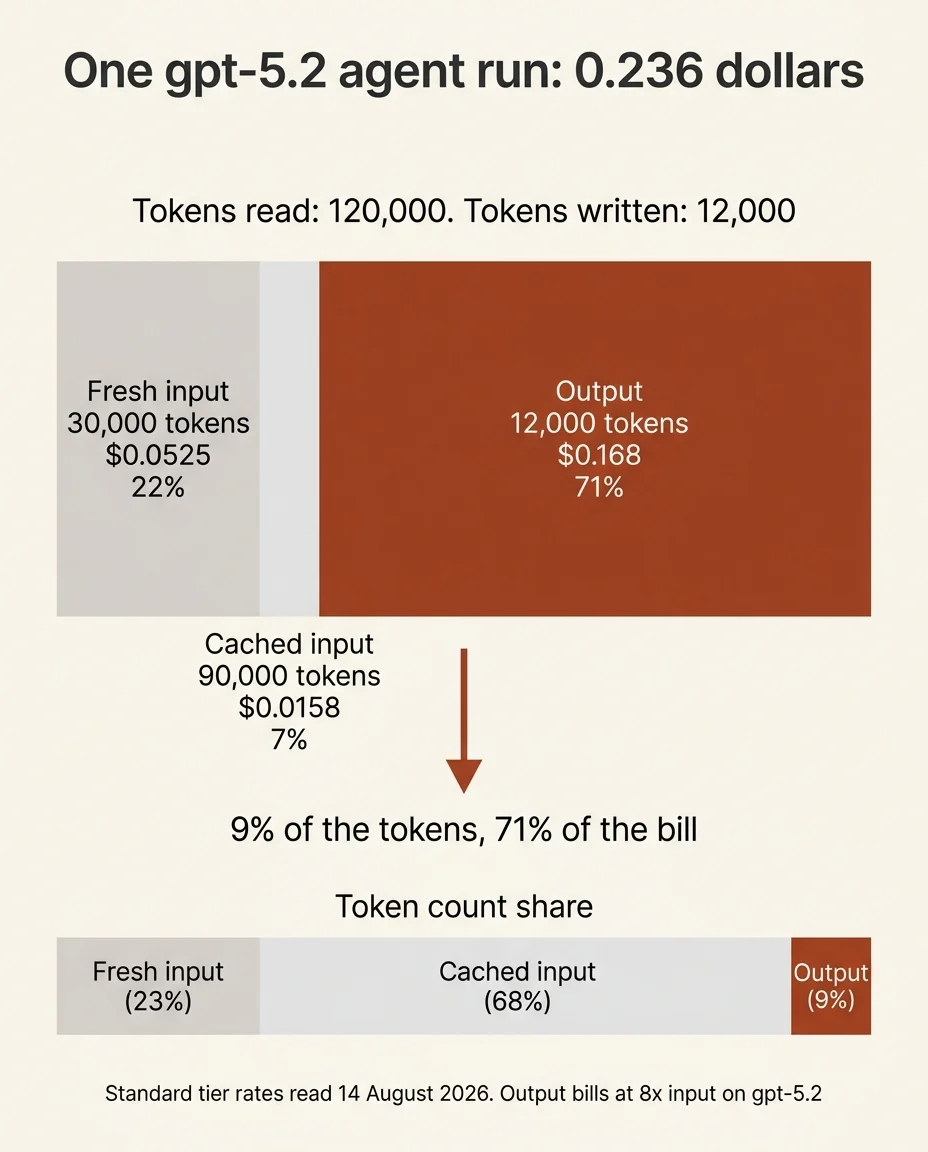
Nobody buys a million tokens. You buy support replies, document summaries and agent runs, and each of those has a fixed shape: so much input, so much output, repeated thousands of times. Price the shape and the tier question answers itself.
A short support reply with 2,000 tokens of context and 400 tokens of answer costs $0.0035 of input plus $0.0056 of output on gpt-5.2, so $0.0091 per reply. Twenty thousand of those a month is $182. A 20,000 token document reduced to an 800 token summary costs $0.035 of input plus $0.0112 of output, so $0.0462 per document, or $46.20 for a thousand documents.
The interesting one is the agent run. Take 120,000 tokens of context with 75 percent of it served from cache, and 12,000 tokens of generated output. The fresh input costs $0.0525, the cached input costs $0.01575, the output costs $0.168, for a total of $0.23625 per run. Output alone is 71 percent of that bill. Six thousand runs a month lands at $1,418. Run the same thing with caching switched off and the input jumps to $0.21, the run costs $0.378 and the month costs $2,268.
That is the whole argument for pricing per task. On the reply workload gpt-5.6-luna is 10 times cheaper than gpt-5.2 and the absolute difference is $164 a month, which almost nobody should care about. On the agent workload the same tier gap runs into four figures monthly, and that is where the choice earns its analysis.
The counterweight is completion rate. A task a cheap model hands back half done costs you the cheap call plus the expensive retry plus the human who reviewed both. The GDPval work, which grades models on real occupational deliverables rather than text answers, is the closest public proxy for that: the post below reports GPT-5.2 winning or tying against human experts on a large share of those tasks. We have not rerun it, and you should read it as a vendor benchmark reported by a third party, not as our measurement.
Load the post on X: GDPval results for GPT-5.2
Rohan Paul walks through the GDPval scores, the benchmark where tasks come with reference files and the expected output is a finished deliverable such as a document, a spreadsheet or a set of slides.
Batch, priority, and cached input: three prices for one model
The same gpt-5.2 weights are sold at three different rates, and the spread between the cheapest and the most expensive is four to one on output.
The Batch API halves everything: $0.875 input, $0.0875 cached input, $7.00 output, in exchange for results returned within a 24 hour window instead of immediately. Priority processing doubles everything: $3.50 input, $0.35 cached input, $28.00 output, in exchange for lower and more predictable latency. Cached input, which applies when a request repeats a prefix the API has already seen, drops input to a tenth of the standard rate.
This is also why third-party pricing trackers disagree about gpt-5.2. A tracker that reports the cheapest rate it can find will quote $0.875 and $7.00, which is the Batch line rather than a price cut on the standard tier. Check which of the three columns a quoted figure came from before you build a budget on it.
Most teams pay the standard rate for work that would have been perfectly happy overnight. Classification backfills, bulk labeling, nightly summarization of yesterday’s tickets, evaluation runs: all of that is batch work, and moving it cuts the line item in half with no model change and no quality change. The reverse mistake is rarer but more expensive, which is buying priority processing for a background job where nobody is waiting on the response.
Caching is the one that reorders your architecture rather than your invoice line. It only pays if your prompts share a long stable prefix, so it rewards putting the system prompt, the tool definitions and the retrieved corpus first and the variable part last. Teams that interleave variable content through the prompt get almost nothing from it.
Where gpt-5.2 stops being the right line
Three specific boundaries, each of which you can check against your own numbers rather than take on trust.
The 8 to 1 rule against gpt-5.6-terra
gpt-5.6-terra costs more than gpt-5.2 on input ($2.00 against $1.75) and less on output ($12.00 against $14.00). So there is a crossover, and it falls at an input to output ratio of exactly 8 to 1. Below that ratio, meaning your tasks generate a lot relative to what they read, terra is cheaper. Above it, meaning long context and short answers, gpt-5.2 is cheaper.
Check it at the crossover: 8 million input tokens and 1 million output tokens costs 8 times $1.75 plus $14.00, which is $28.00 on gpt-5.2, and 8 times $2.00 plus $12.00, which is also $28.00 on terra. The support reply above sits at 5 to 1, so terra wins it at $176 against $182. The document summary sits at 25 to 1, so gpt-5.2 wins it at $46.20 against $49.60 for a thousand documents. Same two models, opposite answers, decided entirely by task shape.
The 272K ceiling nobody reads until they hit it
gpt-5.5, gpt-5.4, gpt-5.4-pro and the whole 5.6 family carry a second set of prices for requests over 272K of context. gpt-5.2 does not. On sol the long context rate is $10.00 input and $45.00 output, on terra $4.00 and $18.00, on luna $0.40 and $1.80.

If your workload occasionally pushes past that window, the honest cost model is not gpt-5.2 pricing, it is gpt-5.2 for the normal path plus a different model at long context rates for the overflow. Budgets built on the standard grid alone tend to be wrong in exactly the month a customer uploads something enormous. If the overflow model does not have to be an OpenAI one, our LLM API pricing comparison is the faster place to shop that decision.
What you give up on gpt-5.6-luna and gpt-5.4-mini
luna at $0.20 and $1.20 is roughly a tenth of gpt-5.2 on both sides. gpt-5.4-mini at $0.75 and $4.50 sits in between. Both are the correct choice for the large volume of work that is genuinely mechanical: routing, extraction against a fixed schema, classification into a closed set of labels, first-pass triage.
They stop being enough at the point where a task requires holding several constraints at once and deciding between them, which in practice means multi-step agent work, anything where the model has to notice that the instruction and the data disagree, and anything you will not have a human read afterwards. The test we use is simple: run 200 real tasks on the cheap tier, count how many need a retry or a correction, and price the retries at the expensive tier. If the corrected total beats running everything on gpt-5.2, the cheap tier is genuinely cheap. Our testing protocol spells out how we set those runs up.
What the coding and agent numbers buy at this price
gpt-5.2 is positioned on agentic and coding work rather than on raw knowledge, which is consistent with the pricing: it is a small step up from gpt-5.1 in dollars and a large step down from the 5.6 flagships. Third parties published benchmark charts at launch covering the coding suites, and the post below is one of them. Treat those figures as reported rather than verified: we have not rerun the suites, and coding benchmarks are unusually sensitive to harness configuration.
Load the post on X: GPT-5.2 Codex benchmark chart
Lisan al Gaib posts the GPT-5.2 Codex benchmark results, the coding-agent suite that matters most for the workload where this tier’s output pricing actually bites.
What you should take from any of these charts is narrow. A benchmark tells you a model can do a class of task under someone else’s harness. It does not tell you your completion rate on your repository, and the completion rate is the only variable that turns a per-token price into a per-task price. Two hundred of your own tasks is worth more than any published suite.
How much does GPT-5 cost, in plain numbers?
If you arrived looking for the older line rather than gpt-5.2, the same grid on 14 August 2026 lists gpt-5 at $1.25 input, $0.125 cached input and $10.00 output. gpt-5-mini is $0.25 and $2.00, gpt-5-nano is $0.05 and $0.40, gpt-5-pro is $15.00 and $120.00. gpt-5.1 matches gpt-5 exactly at $1.25 and $10.00, which makes gpt-5.1 the obvious default over gpt-5 and makes the 40 percent step to gpt-5.2 the real decision.
One clarification, because the two get confused constantly: these are API prices, billed per token against a key. The ChatGPT subscription is a separate product on a separate meter, and we did not check its price on this pass, so do not read any of the numbers on this page as the cost of a ChatGPT plan.
How we checked these prices, and what we did not check
Every figure on this page was read from the OpenAI pricing documentation on 14 August 2026 and read a second time on the same day against the individual model rows, including the Batch API and priority processing columns for gpt-5.2. The screenshot above archives the 5.6 rows of that read, including the long context columns; the gpt-5.2 figures come from the same grid on the same day. Where a cell was empty on the grid, such as the cached input rate for gpt-5.2-pro or the long context columns for gpt-5.2, we say so rather than substitute a number.
What we did not verify: the benchmark scores in the two posts embedded above, which are third-party reports we have not reproduced; the ChatGPT subscription pricing, which is a different product; any enterprise or committed-use discount, which is negotiated and not published; and rate limits per tier, which change independently of price. The per-task costs in this article are arithmetic on the published rates using the token counts stated in each example, not measurements of your workload. Vendor pricing moves without notice, so treat 14 August 2026 as the expiry stamp on all of it and reprice before you commit a budget.
Frequently asked questions
Is gpt-5.2 cheaper than gpt-5.1?
No. gpt-5.2 costs $1.75 input and $14.00 output against $1.25 and $10.00 for gpt-5.1, exactly 40 percent more on both. The newer version number is not a discount, and gpt-5.1 remains the cheaper default for anything that does not specifically need the newer line.
How much does 1 million gpt-5.2 tokens cost?
It depends entirely on the split. A million tokens of pure input is $1.75. A million tokens of pure output is $14.00. A realistic mixed million at four parts input to one part output is $2.80 of output plus $1.40 of input, so $4.20. Quoting a single price for a million tokens without stating the split is meaningless.
What is the cheapest way to run gpt-5.2 at volume?
Batch API plus prompt caching, stacked. Batch halves the rate to $0.875 and $7.00, caching cuts repeated input to a tenth. On a prompt with a long stable prefix, both together take the effective input cost close to a rounding error and leave output as essentially the whole bill, which is where you should then attack the token count itself.
Should you use gpt-5.2 or gpt-5.2-pro?
gpt-5.2-pro is exactly 12 times gpt-5.2 on both input and output, at $21.00 and $168.00, and it has no cached input rate, so long repeated prefixes cost full price. That is a ratio that only makes sense for low-volume, high-stakes tasks where one wrong answer costs more than a thousand right ones save. For anything you run thousands of times a day, it is the wrong instrument.