
xAI charges $2.00 per million input tokens and $6.00 per million output tokens, the same rate on grok-4.6 and grok-4.5, read from the x.ai pricing page on 14 August 2026. That three-to-one gap between output and input is the tightest in the frontier tier we track, where the usual multiplier runs from five to six times. The catch is that xAI published no cached-input discount on the day we checked, so context you send again is billed at full price while rivals bill it at a tenth. The comparator below prices your own monthly volume against grok-4.6 and the two models that charge exactly the same for input.
Grok API cost comparator
Set your monthly volume. grok-4.6 is priced here against the only two rivals that charge the same rate for input, so every difference below comes from the output price and the cache discount. Rates read on 14 August 2026.
Standard tier, published rates excluding tax, no batch or priority pricing applied. xAI listed no cached-input rate on 14 August 2026, so raising the cache share does not move the Grok line.
What xAI charges per million tokens
xAI prices its general-purpose text models per million tokens on the standard tier, with no minimum commitment. On 14 August 2026 that grid showed $2.00 for input and $6.00 for output, and it carried no cached-input column at all. Everything below is what x.ai was publishing that day, and the screenshot is the record we keep so any figure here can be traced back to its source.
grok-4.6 and grok-4.5 share one grid
The unusual part of the xAI grid is that the current flagship and the generation before it cost exactly the same. grok-4.6 and grok-4.5 are both billed at $2.00 in and $6.00 out per million tokens, both with a 500,000-token context window. Most providers hand you a cheaper legacy tier and let you trade a generation of capability for a lower invoice. xAI does not, so dropping back to grok-4.5 saves you nothing. In practice that removes a decision rather than costing you money: you run the newer model because it is free to do so.
| Model | Input per 1M | Output per 1M | Cached input | Context |
|---|---|---|---|---|
| grok-4.6 | $2.00 | $6.00 | not offered | 500k |
| grok-4.5 | $2.00 | $6.00 | not offered | 500k |

Imagine, priced per image rather than per token
The Imagine image API sits on a different basis entirely. On the same day it read $0.01 per image on input and $0.05 per image on output at 1K resolution. Those are per-image rates, not per-million-token rates, so they never enter the comparator above and they belong on their own budget line. Ten thousand generated images a month at 1K is $500 of output cost regardless of what your text traffic is doing, which tends to surprise teams who assume image calls are a rounding error next to a chat workload.
The three-to-one output ratio, the tightest of the frontier tier
Every provider charges more to write than to read, because reading your prompt is one pass over the text while writing an answer runs the model once per token produced. What varies is the multiplier. OpenAI applies roughly six times across the gpt-5.6 line. Anthropic applies five times on Claude Opus 5 and Claude Sonnet 5. xAI applies three, and that single number is most of the story of Grok pricing.
The comparison is unusually clean because the input price is identical. grok-4.6, gpt-5.6-terra and Claude Sonnet 5 all charged $2.00 per million input tokens on 14 August 2026. Every difference between them sits on the output side, where Grok reads $6.00 against $10.00 for Sonnet 5 and $12.00 for terra. Nothing else is in play: no volume tiers, no bundled credits, just the rate at which each one bills the tokens it writes.
Take a genuinely verbose workload, a drafting assistant that reads 2 million tokens a month and writes 10 million. On grok-4.6 that is $4.00 of input and $60.00 of output, $64.00 in total. The same month costs $104.00 on Claude Sonnet 5 and $124.00 on gpt-5.6-terra. The gap is not marginal: Sonnet 5 bills 63 percent more for that month and terra 94 percent more, and all of it comes from the ratio.
No cache discount, and what that costs on repeated context
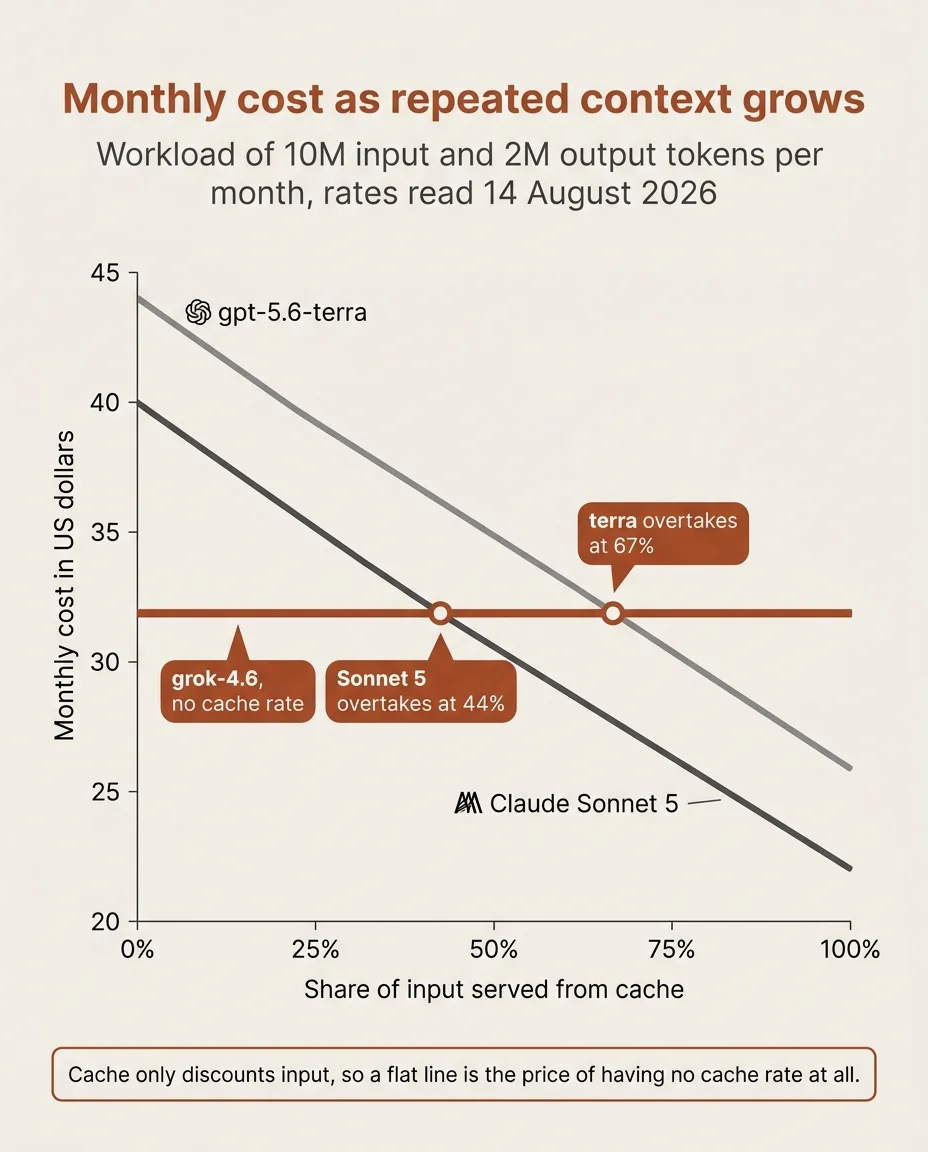
Now the other half of the picture. When you send the same content on every call, a system prompt, a retrieved document set, a conversation history you keep replaying, most providers bill the repeated part at a fraction of the normal input rate. Anthropic reads cached input on Claude Sonnet 5 at $0.20 per million against $2.00 fresh. OpenAI does the same on gpt-5.6-terra, also $0.20. On 14 August 2026 the xAI page listed no cached-input rate at all, which means repeated context is billed at $2.00 per million every single time you send it.
Flip the workload around to see what that costs. A retrieval assistant that reads 10 million tokens a month and writes 2 million pays $32.00 on grok-4.6 whatever its cache hit rate, because there is no cache rate to hit. Claude Sonnet 5 starts at $40.00 with no repetition, drops to $31.00 once half the input repeats, and reaches $25.60 at 80 percent. The crossover lands near a 44 percent cache hit rate. Against gpt-5.6-terra, which pays more on output and therefore starts further behind, the crossover sits near 67 percent.
So the verdict is conditional rather than flattering. Grok is the cheapest of the three on any workload where output dominates, and it stays cheapest on balanced workloads until repeated context becomes the majority of what you send. Past that point the missing discount outweighs the better ratio, and it does so quietly, because nothing on an invoice announces the cache you did not get.
Grok against gpt-5.6-terra and Claude Sonnet 5 on the same workload
The comparator at the top of this page runs exactly that arithmetic on your own numbers. It is deliberately limited to three models that share an input price, because that is the only way to watch the output ratio and the cache discount work against each other without a dozen other variables in the way. For the full grid across every provider, including the cheap tier and the long-context surcharges, see our LLM API pricing comparison.
A verbose workload
Anything that turns a short prompt into a long document: report generation, code synthesis, marketing copy at volume, transcript cleanup. Output runs several times input, cache is close to irrelevant because the prompts are short and rarely identical, and the output multiplier decides the bill on its own. grok-4.6 wins this profile outright and the margin widens with volume. Nothing in the rival grids can close a three-to-one gap on the side of the ledger that is doing all of the spending.
A repeated-context workload
Anything that reads far more than it writes with a stable preamble: customer support on a fixed knowledge base, retrieval over a document corpus, agents that carry a long system prompt through every step. Input dominates, most of it repeats, and cached rates become the single biggest lever available to you. Here the Grok advantage evaporates, and the 500,000-token window is worth more to you than the price is. Set the cache field in the comparator to 75 percent and watch the ranking invert.
What developers are building on the Grok API
A pricing page tells you the rate, not whether the model earns it. The more useful signal is what people ship on it and what they measure afterwards, particularly on coding and agentic tasks, where xAI has pushed hardest and where token volumes get large enough for a three-to-one output ratio to show up on a real invoice.
Grok Build 0.1 caught all ten planted bugs in a React and TypeScript application, ahead of every frontier model in the run on both coverage and cost, at $0.29 a run against $0.45 for the next best.
That run comes from Kilo Code, posted on X and read on 14 August 2026. Benchmarks published by tool vendors deserve the usual scepticism about the harness and the choice of comparison. A run that names the model, the task and the cost of the run is at least reproducible, though, which is more than most model comparisons offer, and cost per run is the number that connects a benchmark back to the grid at the top of this page. Note that grok-build-0.1 is a separate coding model: it was not in the part of the grid we captured, so it is not priced on this page and it is not in the comparator.
How we checked these prices
Every xAI figure on this page was read from the provider’s own pricing page on 14 August 2026 and captured as the screenshot above. We do not take prices from aggregators, because aggregators lag and rarely date their entries. What we verified is the standard-tier per-million rate for grok-4.6 and grok-4.5, the 500,000-token context on both, the absence of a cached-input line, and the Imagine per-image rates at 1K resolution.
What we did not verify, and will not assert: batch tiers, off-peak windows, enterprise commitments, regional endpoints, any discount available under a negotiated contract, and the rate for grok-build-0.1, which sits outside the section of the grid we captured. If xAI publishes those somewhere, they were not on the part of the page we read. When the grid moves we update the number and say what moved, rather than editing the page in silence.
Frequently asked questions
Is grok-4.5 cheaper than grok-4.6?
No. Both read $2.00 input and $6.00 output per million tokens on 14 August 2026, with the same 500,000-token context. There is no cost argument for staying on the older generation.
Does xAI offer a batch discount?
We found none on the pricing page we read on 14 August 2026. Treat every figure here as standard tier only, and confirm with xAI before budgeting against a discount we could not see published.
What does the 500k context change in practice?
It changes what fits in a single request rather than what a token costs. With no cached-input rate, a large context is billed in full on every call: a 400,000-token preamble sent a thousand times a month is $800 on Grok, against $80 on a provider charging $0.20 for cached input. Big windows and absent cache pricing are an expensive combination.
Is Grok the cheapest frontier model?
On output, yes, among the frontier tier we track. $6.00 per million sits below Claude Sonnet 5 at $10.00, gpt-5.6-terra at $12.00 and everything above them. Cheaper models exist, Mistral Large 3 at $1.50 and DeepSeek V4-Flash at $0.28 on output, but they sit a tier below on capability rather than competing with grok-4.6 head on. Our full LLM API pricing grid ranks all fourteen models we track on the volume you actually run.
How often is this page rechecked?
Whenever xAI ships a model or changes a tier, and on the routine pass we run across the rest of the pricing grid. Each figure carries the date it was verified, so you can judge the freshness yourself instead of trusting a generic update stamp.